 On museum visits, we view chipped vases decorated with images of women bearing water jars. In Sunday school, we learn about the woman-at-the-well.
“Water-haulers” of the world. That’s what UNICEF calls women and girls. From ancient times to today, it has been the work of women to find water for their families, for drinking, gardening, cooking, and bathing.
And, around the world, women are in the streets, protesting the failure to build and maintain systems to provide and protect safe, clean, free water. In honor of Earth Day, here’s a sampling of women’s creative nonviolent actions for the planet’s most precious resource.
GAMBIA’S “MARATHON WALKER”
 (April, 2015) Last week’s World Water Forum was basically non-news, but social media was flush with photos of Siabatoa Sanneh, the strong and imaginative 43-year-old from Gambia who used the Paris Marathon to generate publicity about the water crisis.
Photographed carrying 20 liters of water on her head and wearing a traditional dress instead of runner’s clothes, Sanneh stood out from the crowd of 56,000 others, got our attention, made us think about water. She told reporters that, like many other women in Africa, she and her two daughters walk the distance of a marathon every day to get drinking water.
SMASHED WATER JARS IN INDIA
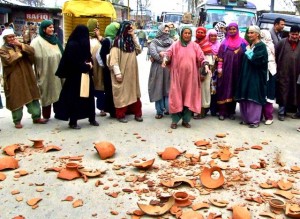 (April, 2015) Women from the town of Sopore stood in the middle of Chanakhana Road earlier this month and threw earthenware pots to the dry ground. The clay shattered and traffic stopped. What good are pots, when there’s no water to fill them?
The women, frustrated by an ongoing water shortage, placed most of the blame for the crisis on members of the legislative assembly (“toothless and useless”) and on the Public Health Engineering department for not fixing damaged pipes. The women told reporters that their families could no longer wait.
KENYAN WOMEN BRING BABIES TO THE BLOCKADE
 (February, 2015) Hundreds of women, some carrying babies, blocked traffic for seven hours to protest the water shortage in Loitokitok.
Babies cried and drivers fumed, but the women stood their ground, demanding to speak to a high-ranking government official. Ordinarily, the police would have used teargas, but they held back because of the babies.
The Deputy Governor told the press that he recognized there were problems, but promised that talks were underway to determine how to share water from Mt. Kilimanjaro.
RIO WOMEN INVADE OLYMPIC MEETING PLACE
 (February, 2015) Several women broke through security and invaded the hotel where organizers were planning the 2016 Summer Olympic Games, objecting primarily to the new golf course and luxury apartments being erected in the city.
The women didn’t make it past the lobby, but managed to garner media attention to the concerns of groups like “Occupy Golf” and “Golf for Whom?” outraged that, to build the golf course, developers took part of a once-protected nature reserve, home to several endangered species of butterflies and frogs, bulldozed the land, and uprooted several hundred trees.
Southern Brazil is experiencing its worst drought in 80 years. From São Paulo to Rio de Janeiro people are suffering water rationing and rolling power cuts that limit access to light and the Internet. One district of Rio has been without tap water since December. Yet, while residents are making heroic efforts not to waste a drop, sprinklers are spritzing the new golf course to keep that grass lush and green.
TURKISH WOMEN SAY “NO WATER, NO SEX”
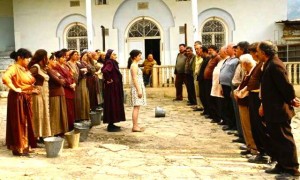 (August, 2001) Women in rural Sirt endured months of inadequate water supply, forcing them to wait in long lines at a fountain. Fed up, they declared, “No water, no sex” and called for a Bedroom Boycott. The men soon petitioned the local governor for assistance and got the 27-year-old water system repaired. This successful action inspired two films. (Movie still: “Absurdistan” — see YouTube clip below.)
NIGERIAN WOMEN SHOCK SHELL
 (January, 2014) Although Nigeria is one of the world’s major oil producers, the Niger Delta, where the oil is found, remains poor and undeveloped. Women in Bayelsa State blamed Shell. The oil company had not kept its promises to provide clean drinking water for the local population, replace a faulty generator, and renovate a school.
Hundreds of women marched through Peremabiri with bare breasts and blocked the entrances to the oil platform with red cloth. They carried signs that read “SHELL: WE NEED WATER, LIGHT, SCHOOL FOR OUR CHILDREN.”
TO GO DEEPER
Water For Africa website: http://www.waterforafrica.org.uk This non-profit organization builds boreholes, sustainable water sources, greatly shortening the distances that women must walk each day to find water.
“When Restive Sopore Town Broke Pots in Protest” Kashmir Life, April 8, 2015.
“Loitoktok Women Take Babies to Protest Against Water Shortage” by Kurgat Marinday, The Star, February 26, 2015
“Half-nude Women Protest Against Shell in Bayelsa” Ecowas Tribune, January 8, 2014
“Drought-hit Rio Braces for Carnival Water Shortages” by Adriana Brasileiro, Reuters, Feb. 12, 2015
Women and Water, excellent video overview by Water For People (3:09 mins)
The 2001 Turkish sex strike inspired two modern films. The 2008 award-winning German-French comedy Absurdistan, directed by Veit Helmer and filmed in Azerbaijan, tells about two young lovers in a remote Soviet village, caught up in a sex strike for repair of a water pipeline. Absurdistan (2 min trailer)
 In Lysistrata, that bawdy old Greek comedy, scantily clad women fed up with the Peloponnesian War lured their warrior husbands home, then slammed shut the bedroom doors, so to speak, promising to open up when peace was declared.
 ● @1600, Iroquois Nation — Noting that they produced the warriors, women threatened to forego childbearing until men conceded some decision-making powers on the war council.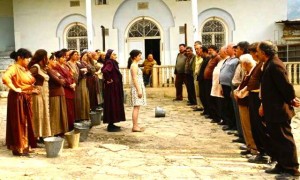

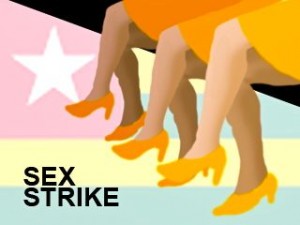 ● 2006, Colombia — Proclaiming a “strike of crossed legs,” women in Pereira withheld sex to stop gang wars and drive home the point that violence is not sexy. The ten-day strike may have worked. By 2010, Pereira’s murder rate declined by 26.5 percent.
 ● 2011, Philippines — Women in a sewing cooperative on rural Mindanao Island were unable to sell their wares because violence between men in rival villages had closed the main road. They called for a sex strike. Within a few weeks, the road was opened and deemed safe for travel.
 ● 2012, USA — The Texas-based Liberal Ladies Who Lunch set up a Facebook page urging women to withhold sex for a week, not as a weapon against men, but as a reminder that “if women lose our hard won rights to medical care, birth control, and pregnancy choice, it won’t only affect women.” The strike proposal was made somewhat tongue-in-cheek, but the demand that congress and insurance companies cover contraception was serious.
 Musical & Theatrical Sex Strikes:
 The 2001 Turkish sex strike inspired two modern films. The 2008 award-winning German-French comedy Absurdistan, directed by Veit Helmer and filmed in Azerbaijan, tells about two young lovers in a remote Soviet village, caught up in a sex strike for repair of a water pipeline. Absurdistan (2 min trailer)
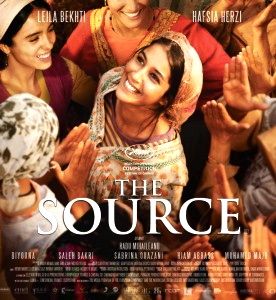 The 2011 French film, The Source, directed by Radu Mihāileanu, is set in a small Arab village in North Africa, where women go on a “love strike” to protest their hard labor carrying water from the mountains. (2-minute trailer)