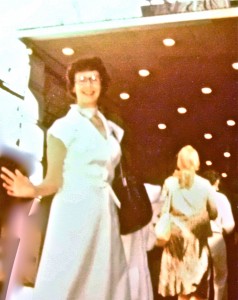
 Magicians and scientists know that what we expect to see affects what we will see. Every time my parents visited me in NYC, I experienced this firsthand.
Dad expected pushy people and lots of graffiti. Inevitably, that’s what he saw. Mom, on the other hand, saw bright lights and fascinating characters.
A GREETING OF HOPE
At the Global Feminist Disarmament conference (Barnard, June 1982), I took part in a ritual of expectation that has had a lasting effect on me
One woman at the conference was secretly designated the “Peacemaker.” The rest of us were instructed to circle the room, greeting each other with the question, “Are you the Peacemaker?” We were told that, when we found her, the Peacemaker would ordain us as sister peacemakers.

I remember thinking, dear God, this is gonna take forever. What a stupid waste of time.
But a surprising thing happened. After only a few minutes, the Peacemaker’s blessing had touched enough of us so that we found ourselves anointing each other, recognizing each other as peacemakers. More importantly, we nodded yes when asked, “Are you the Peacemaker?” “Yes. Yes I am.” We were transformed.
A GREETING OF CONFORMITY
 Decades earlier, another greeting had a profound effect on people. Within weeks of the Nazi’s rise to power, the “Heil Hitler” salute was made mandatory. It became the normal greeting on the street, at work, in school. People had “Hitler” on their lips and in their heads all day long.
Students were required to begin class with the salute. At first, teenaged Hiltgunt Zassenhaus (1916-2004) refused. Her friends said, “Just raise your arm and mumble something. Why get into trouble for this? It’s just a gesture.” She persisted, was sent to the principal, and threatened with expulsion.
 The teacher looked the other way until the day an authority came to observe the class. That day, with everyone watching, Zassenhaus stood when the class stood. When they raised their arms, so did she — but she deliberately thrust her arm through a window by her desk and had to be rushed to the hospital. Her defiant gesture was a metaphor for bloodshed to come.
Eventually, Zassenhaus used the salute to camouflage her work in the resistance to the Third Reich, described in her powerful memoir, Walls.
These two greetings represent a contrast in expectations. “Are you the Peacemaker?” holds the expectation of hope, of finding the best in the person being greeted and being reminded of our own best potential when the greeting is returned. “Heil Hitler” holds the expectation of conformity, fear, and obedience to authority.
MY FAVORITE HASIDIC FOLKTALE
The abbot of a dying monastery sought the advice of a wise rabbi. “I only have four elderly monks left,” he wept. “They’re sad and surly. What can I do?”
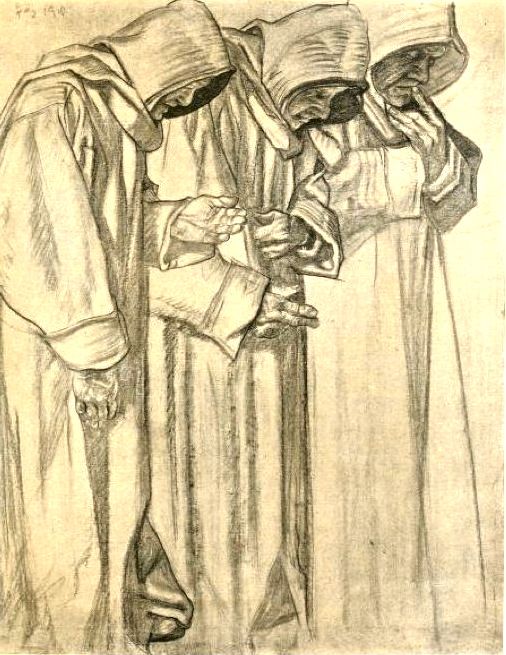 The sage shook his head. “I’m sorry to hear this, my friend, and a bit surprised. You see, rumor has it that the Messiah is one of you.”
The abbot returned with the rabbi’s message. The monks were mystified. They began to wonder about each other with a new generosity of spirit. Could Brother Thomas be the Messiah? He’s slow; then again, he’s patient and kind. Maybe it’s Brother Phillip; he seems simple; maybe it’s innocence. Once in awhile, they dared ponder the unthinkable: “Could it be me?” and with that thought came the faintest glimmer of possibility.
Now, when travelers passed the monastery, they found a few old men who radiated love and showed each other deep respect and compassion. People began stopping by to picnic on the lawn, just to be near them. Soon, the monastery was thriving again, all because of a few words from a wise rabbi.
To Go Deeper
~ Walls: Resisting the Third Reich, One Woman’s Story by Hiltgunt Zassenhaus (Beacon Press, 1976) http://www.goodreads.com/book/show/875646.Walls
~ “The Rabbi’s Gift” (one of many variations) http://www.community4me.com/rabbisgift.html
Graphics
~ My Mom at A Chorus Line
~ Do you see the face hidden in the dove? Logo from Women PeaceMakers, U. of San Diego, Institute for Peace and Justice
~ Adults and children giving the Nazi salute
~ Study of Monks “For a Panel in St. Aidan’s Church, Leeds,” Source: Sparrow, Prints and Drawings by Frank Brangwyn. Credit: Internet Archive and the Ontario College of Art and http://www.victorianweb.org/painting/brangwyn/drawings/18.html
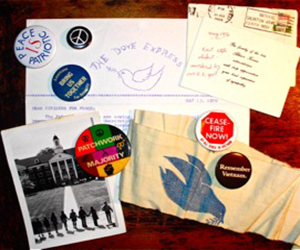 I made a promise forty-four years ago, that the spirit of Allison Beth Krause would live on in my heart.
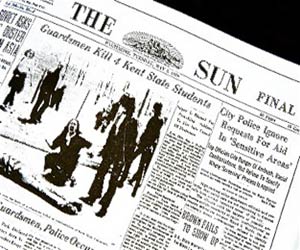 I remember, as if in a dream, how word of the Kent State killings spread across the little college campus in the middle of Pennsylvania, where I, too, was a politically-involved, bright-eyed freshman. In my memory of that soft dusk, we all seemed to be running and whispering, whispering, whispering the news. I remember the shock. I remember thinking, “This is real! This is real! It could have been me. It could have been me.”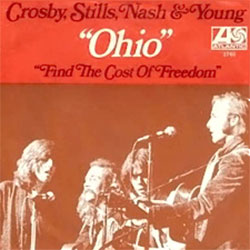
 One was my week visiting radical feminist pacifist Barbara Deming and her partner Jane Gapen in the Florida Keys. I’d read Barbara’s books in college (Revolution and Equilibrium and Prison Notes). Most of my understanding of nonviolence was a direct result of her writing. She eventually became my mentor. Through her, I came to understand the vital link between feminism and nonviolence.Mornings at Sugarloaf Key were spent reading, bike riding, and exploring the tropical landscape, while Jane worked in her art studio and Barbara wrote, slowly pecking out an occasional sentence on her typewriter.
 Two days after I left the Keys, I visited a women’s collective in northern Florida. These women slept with pistols beneath their pillows, prepared to use guns for self defense.
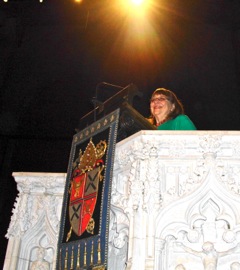 Perhaps this has something to do with why, sixty years later, I was invited to read my Pride poem from the pulpit at the Cathedral of St. John the Divine, one of the largest Gothic cathedrals in the world, to kick off the “Four Choirs and a Cathedral” concert. It really was a once-in-a-lifetime thrill to climb up into that awesome pulpit (about the size of a NYC apartment) and then hear the Stonewall Chorale, NYC Gay Men’s Chorus, Empire City Men’s Chorus, and Lavender Light (lesbian & gay gospel choir). What a night it was!
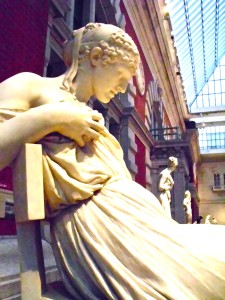 our Sapphic verses, each Wilde kiss.
 we step with pride from shadows,
 “friend of Dorothy”