Activists With Attitude

thoughts on courage and creativity

  • Home
  • Pam’s Books
  • Savvy Sites
  • Cool Quotes
  • Archive
You are here: Home / Archives for 2014

Archives for 2014

A Woman’s Strike in Burkina Faso

October 3, 2014 By Pam

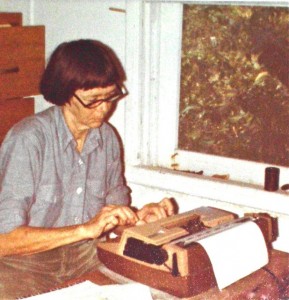
14-BarbaraTypingIf women ever really went on strike and refused our assigned roles, “Everything, everything would have to change!” So wrote my mentor, Barbara Deming (1917-1984), pacifist, lesbian-feminist author-activist.

This week, the focus of my writing has been a chapter about women’s use of strikes — the collective withholding of labor, symbolic strikes (Women’s Strike for Peace), and Lysistrata actions (withholding sex or birthing). It’s an exciting action-packed chapter, fun to research. I love reading about Annie Besant and the Matchgirls’ strike in London in 1888 and the Uprising of the 20,000 shirtwaist workers in 1909 NYC and the garment workers massive actions last year in Bangladesh. All of it — inspiring!

This month, I will share tidbits from this chapter-in-progress. Today — the story of a one-day woman’s strike in Burkina Faso, the little landlocked nation in West Africa. Enjoy!

President Sankara’s “Mad Act”

14-Sankara-Quote“You can’t make fundamental changes in society without the occasional mad act.” That’s what President Sankara boldly proclaimed when he came up with the idea for “Market Day for Men.” Indeed, it seemed a mad act.

In Burkina Faso, in 1984, women went daily to the market, rain or shine, having no way to preserve food at home. They left early in the morning, often walking long distances. At the market, they selected produce and haggled with vendors to get the most out of their food money, doled out to them each day by their husbands. Then, they carried the heavy loads back home and prepared the family meal.

Joséphine Ouédraogo — On Board with the Bold Experiment
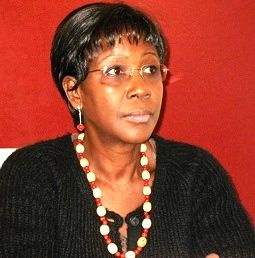
14-OuedraogoIn the few years before his assassination and the coup, President Sankara appointed several women to high positions, including second in command at the Ministry of Defense. For Minister for Health and Family Welfare, he appointed Joséphine Ouédraogo. She was trained as a sociologist and worked for the revolutionary government from 1984 to 1987.

Inspired by Sankara’s commitment to speak for the “great disinherited people of the world,” Ouédraogo worked to eradicate the custom of female genital mutilation, helped develop new laws governing family life, promoted the distribution of contraceptives, fought against discrimination, and advocated for marginalized groups. After the overthrow of the revolutionary Sankara regime, she was out of a job. In 1997, she was appointed head of the United Nations’ “African Center for Gender and Development” and, in 2007, was named Executive Director of Enda Third World, an international organization based on Senegal.

Market Day for Men — The Revolution Bursts Into the Family!

14-market-distantThe mid-1980s was a time of great change in Burkina Faso, a country that traditionally had a strict division of labor along gender lines. In September, 1984, with the blessing of both President Sankara and Minister Ouédraogo, the women in the Committee for the Defense of the Revolution called for a one-day women’s strike and, simultaneously, a “Market Day for Men.” They urged community leaders — priests, imams (Muslim prayer leaders), teachers, and news reporters — to encourage support for the experiment.

The people in the capital city of Ouagadougou were given fair notice of the event in a media campaign, but the date was kept a secret so that women would not do extra shopping the day before to spare their husbands. At eight p.m. on Friday night the word came: the strike was to be the next day, September 22.

Bright and early Saturday morning, the experiment began. Women handed over their shopping lists, and the men were on their way — in a torrential rain.

Where Are the Cashews? How Much for Mangoes?

14-Market-foodAt each marketplace, the men were greeted by teams of militant women from the Committee for the Defense of the Revolution. They stopped women from entering the markets unless they were single or had husbands who were ill that day.

The marketplaces proved alien to the men, most of whom wandered in confusion, as if they were lost on a strange planet. They asked about prices and were alarmed at the figures quoted. Not adept at bargaining, they handed over the money and hurried on to buy the next item on their lists. Finally, they carried their heavy loads home, realizing from their aching backs, tired feet, and pounding heads the frustrations and fatigue the women lived with daily.

Joséphine Ouédraogo later wrote of that day:

The atmosphere was fantastic, as much for those who “played the game” as for those who found it “absolutely ridiculous.” It was well worth it. It provoked unexpected debate in all quarters. The revolution had burst into the family and pointed an accusing finger at the masculine conscience!

To Go Deeper: 

14-Book-Cover

“Everyday Heroes — Joséphine Ouédraogo (Burkina Faso)” on the blog: Trust Africa.

“Women of Vision — Burkina Faso” on the blog: Gender Equality and Women’s Empowerment.

“The Revolution Cannot Triumph Without the Emancipation of Women: A Reflection on Sankara’s Speech, 25 Years Later” by Amber Murrey, Speech given at Oxford University, June 8, 2012, published in the International Journal of Socialist Renewal

BOOK: Women’s Liberation and the African Freedom Struggle by Thomas Sankara, Pathfinder Press, 2007


Filed Under: Featured Tagged With: Barbara Deming, Burkina Faso, Josephine Ouedraogo, Market Day for Men, Ouagadougou, President Sankara, Thomas Sankara, woman’s strike, women’s liberation, women’s symbolic strike

Eco-Artists, Swoon & Aylon, Resist Climate Chaos

September 19, 2014 By Pam

OLYMPUS DIGITAL CAMERAAm I in love? Maybe. I’ve never met her, but she’s a 30-something street artist/ social justice activist who goes by the tag Swoon, although her birth name is also pretty fabulous — Caledonia “Callie” Curry. For years, her powerful portraits could be found illegally wheat-pasted on the sides of neglected buildings in gritty Brooklyn’s back alleys.
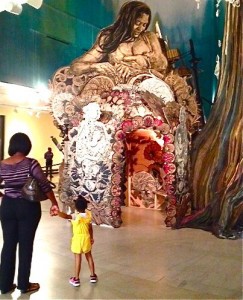
13-Swoon-Gazebo“Submerged Motherlands”

For much of 2014, the Brooklyn Museum devoted its 5th-floor rotunda to Swoon’s Hurricane Sandy-inspired installation. I was lucky enough to see this fantastical landscape — rafts made of salvaged junk (wood scraps, old pipes, bicycle and car parts, rope), larger-than-life portraits including one of Swoon’s ailing mother who recently died of cancer, and a meditation-gazebo topped with a depiction of a breastfeeding woman.

13-Swoon-Tree-MuseumFrom the clutter representing our fragile, dislocated lives with their alarming cycles of growth and decay, rose a magnificent fabric tree (akin to the sacred but endangered Mapou in Haiti). It drew our gaze, repeatedly, to the rotunda skylight, as if we might find relief from our environmental anxieties up there with the delicate cut paper foliage. Swoon believes “we can create little cracks in the façade of impossibility and inevitability.” Standing at the foot of that tree, I, too, believed.

A Tree Grows at the People’s Climate March

Swoon’s “Tree of Life” will rise again, Sunday, September 21, on Manhattan’s 11th Avenue at 35th Street. As we reach the end of the People’s Climate March, we will be invited to inscribe on a ribbon what we fear losing to climate chaos and tie the message to the tree. It will be a visual representation of MLK’s assertion, “We are all tied together in a single garment of destiny.” 

13-Earth-Ambulance-Color“Earth Ambulance” 

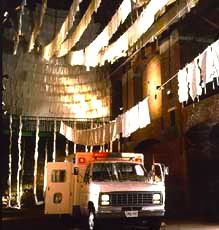
An ambulance driven by two women pulled away from the Lawrence Lab in Berkeley on May 2, 1982. But, while other ambulances raced to rescue sick or injured people that day, this one raced to rescue planet Earth. It was an emergency.

The Earth Ambulance was the vision of Helène Aylon. For years, she worked alone, isolated in her studio, until she heard a lecture by Dr. Helen Caldicott, the famous antinuclear activist from Australia. Aylon vowed then to use her art to bring people together to heal the Earth.

After urging activists not to “cringe from the visionary, the utopian,” Aylon led a women’s caravan on a ceremonial journey across the U.S., stopping at 12 Strategic Air Command (S.A.C.) nuclear bases to collect samples of earth. The soil was put into pillowcases decorated with women’s Earth dreams and nightmares.

13-Aylon-Earth-PaintingsThe caravan arrived in New York City in time for the historic June 12th March for Disarmament. The women unloaded the full pillowcases from the ambulance and poured the soil onto old army stretchers from Korea and Vietnam.
In solemn procession, they carried the stretchers through a crowd of one million, to a park near the U.N. and poured the ailing earth into 12 grave-length transparent boxes, each box neatly labeled for the soil it held. There was sandy soil from Vandenberg S.A.C. in southern California; clay-colored earth from Los Alamos; dark red earth from the atomic lab near Pittsburgh. Passersby stopped to look at the planet’s soil, moved by its beauty.

13-Aylon-at-Anchorage-COLORMonths later, pillowcases from the Earth Ambulance were hung like laundry on clotheslines in Dag Hammarskjold Plaza. For two weeks, people stopped to read Earth dreams and nightmares. At night, women camped out there, the dream-laden “sacks” hanging over them, waving in the breeze. Plaza police looked on, mistakenly assuming that official permission had been granted.

I got to see the pillowcases in the Plaza and again at the Seneca Women’s Encampment for a Future of Peace and Justice, where I added one to the collection.

In 1992, I saw the Earth Ambulance, sans rescued soil. Aylon had filled it to the top with seeds from Native American lands and parked it in the Brooklyn Bridge Anchorage. Pillowcases were hung on clotheslines above the ambulance, while a video played, showing the caravan’s 1982 trip.

I still have the handful of seeds viewers were invited to take as a memento of hope for the planet’s future.

To Go Deeper       

13-Swoon-WomanSWOON

 “Life of Wonderment: Swoon Blurs the Line Between Art and Activism” by Melena Ryzik, The New York Times, August 6, 2014,

“Brooklyn Museum Features Swoon: ‘Submerged Motherlands‘” by Richard Friswell, Artes Magazine, July 2, 2014

Website: The Climate Ribbon


“Walrus TV Artist Feature: Swoon Interview from The Run Up” (10 minutes)


“Submerged Motherlands” environmental art at the Brooklyn Museum, 2014 (3 minutes)

13-Aylon-BookHELENE AYLON

“The S.A.C./ SAC Voyage of the Earth Ambulance” by Helène Aylon, WEAD (Women Environmental Artists Directory) Issue #5

“A Woman on a Mission” by Leslie Knowlton, Los Angeles Times, February 24, 1995

Website:  http://www.heleneaylon.com/

Book: Whatever Is Contained Must Be Released: My Jewish Orthodox Girlhood, My Life as a Feminist Artist, by Helène Aylon, The Feminist Press, 2012 (Also available on Kindle)


“Bridge of Knots” Helene Aylon’s pillowcase performance art (2 minutes)


Filed Under: Featured Tagged With: “Submerged Motherlands”, Brooklyn Museum of Art, Caledonia “Callie” Curry, Earth Ambulance, environmental art, Helen Caldicott, Helène Aylon, People’s Climate March, Swoon

From Seven Seedlings, a Canopy of Hope

September 11, 2014 By Pam

12-Women-plantingSomething was very wrong, and Wangari Maathai knew it. She saw that women in Kenya had to walk farther each day for water and wood and realized that the cause was a policy of rapid deforestation which had left big swaths of the nation bare and dusty. The authorities didn’t seem to care.

Educated in the U.S., Africa, and Europe, Wangari was the first woman in East Africa to earn a doctorate. Fortunately, her advanced degrees did not separate her from the community, but deepened her roots.

12-Wangari-blue-tree

On World Environment Day, 1977, Dr. Maathai planted seven seedlings in honor of seven female environmentalists of Africa and, with that, launched the Green Belt Movement. This was her answer, her prayer, her way of reclaiming the power to heal the earth. She told her sisters that, “like a seedling, with sun, good soil, and abundant rain, the roots of our future will bury themselves in the ground and a canopy of hope will reach into the sky.” (from Unbowed)

Authorities went from not caring to caring a lot. At first they laughed when they saw women in village after village planting trees. The women lacked proper training, they said.

In an interview with Marianne Schnall at Feminist.com, Wangari remembered:

I started with ordinary women from the countryside expressing their very basic needs for water, for food, for firewood, and for income, and then realizing that what the women were describing was an environment — they were coming from an environment that was failing to sustain them.

The authorities stopped laughing when Dr. Maathai got women thinking about how much better it would be for their families if they helped promote sustainable agriculture, food-security, and environmentally appropriate crops benefiting the many in place of export commodities profiting the few.


The Highs and Lows of a Celebrity-Activist

12-Wangari-Obama

Because of her clear vision, deep insight, and vibrant, hands-on leadership style, Wangari was in great demand. She spoke about women’s empowerment and environmental issues around the world, worked for democracy and against government corruption, went on a hunger strike for the release of political prisoners, was elected to Parliament, gained international fame, won many awards, and got men involved in the Green Belt cause, including then-Senator Barack Obama. In 2004, she became the first African woman to win the Nobel Peace Prize.

Through all the years of her remarkable success, she was harassed, lied about, scorned, and threatened. Accused of being “too strong-minded for a woman,” her husband divorced her. Unable to support her children, she saw them leave to live with their father. She was beaten unconscious by the police, tear-gassed, jailed, bullied, and publicly mocked. There was international outrage when Wangari and several other environmentalists were attacked and injured while trying to plant a tree on public land that had been privatized and cleared for a golf course.

12-treeWhen Wangari Maaathai died of cancer in September, 2011 at age 71, the whole world mourned. The executive director of the United Nations’ environmental program remembered her as a force of nature and compared her to the acacia trees, “strong in character and able to survive sometimes the harshest of conditions.”

By the time she died, 900,000 women had helped plant 45 million trees which provided a lush canopy of green over their heads, a canopy of hope. And it all began with Wangari’s seven little seedlings.


To Go Deeper

Articles:

12-Wangari-kid-book“Wangari Maathai’s Canopy of Hope: remembering a warrior woman for the planet and role model for us all” by Jennifer Browdy at Transition Times, Sept. 26, 2011

“Conversation with Wangari Maathai” by Marianne Schnall at Feminist.com 12/9/08

“The Legacy of Wangari Maathai: Women as Green Agents of Change” by Wanjira Maathai and Jamie Bechtel, Huffington Post, 10/16/12


Books:

12-Mama-MitiWangari’s Trees of Peace: A True Story from Africa by Jeanette Winter, 2008 (children’s book)

Seeds of Change: Planting a Path to Peace by Jen Cullerton Johnson, 2010 (children’s book)

Mama Miti: Wangari Maathai and the Trees of Kenya by Donna Jo Napoli, 2012 (children’s book with amazing African print illustrations)

Unbowed: A Memoir by Wangari Maathai, 2008 (Dr. Maathai recounts the brutal repression by the Kenyan government and how she started the Green Belt Movement)

Replenishing the Earth: Spiritual Values for Healing Ourselves and the World, 2010  — Maathai draws inspiration from the teachings of the world’s religious traditions, including “tikkun olam” (the Jewish mandate to repair the world”).

Video:


“Wangari Maathai ‘The Tree Lady’ by Will Levitt” — Excellent overview of Maathai’s life, success, challenges, the power of the nonviolent grassroots Green Belt Movement and the empowerment of women. (10 mins)


“The Hummingbird and the Forest Fire” — Wangari Maathai narrates this animated story about doing the best we can, no mater how small, for the environment, from Dirt! The Movie. (2 mins)


“Wangari Maathai Tribute Film” — World leaders, including Al Gore and Bill Clinton, honor the courage of Dr. Maathai. (7 mins)

Photo credit:

Wangari Maathai, photo by Micheline Pelletier

Image of Serengeti tree by Nell for Mahlatini (https://www.mahlatini.com/honeymoons/)

Filed Under: Featured Tagged With: Green Belt Movement, Kenya, Nobel Peace Prize, Seeds of Change, The Hummingbird and the Forest Fire, Unbowed, Wangari Maathai, Wangari’s Trees of Peace

Honoring Women Who Hugged the Trees

September 5, 2014 By Pam

11-AmritaDeviSquareAs we prepare for the People’s Climate March on September 21 here in NYC, I am thinking about some of the brave women who have fought valiantly for the Earth, like the heroines of the Chipko (“tree-hugging”) movement in India.
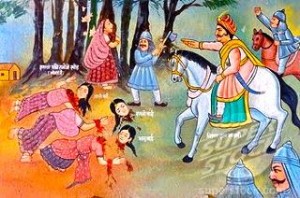
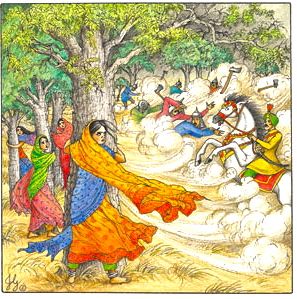
In 1730, Amrita Devi watched men with axes enter her village with an order from the Maharajah — to cut down trees needed to build his new palace.

The trees were the villagers’ source of life, the only green in an otherwise barren landscape. The forest shielded the people from the desert, protected their fragile water supply, provided fodder for the cows and twigs for the fire. What’s more, the trees and animals were sacred and not to be harmed, according to the rules of their Hindu sect.

11-AmritaDeviBeheadedAmrita Devi tried to reason with the men, but they had their orders. They entered the forest with axes raised. Amrita Devi boldly walked past the bewildered men and stretched her thin arms around a tree saying, “If a tree is saved, even at the cost of one’s head, it is worth it.”

What is the life of a peasant woman to men who are bound to obey the orders of a Maharajah? Amrita Devi was beheaded protecting the trees. When her three daughters stepped up to take her place, they, too, were beheaded. It is said that 363 villagers were killed that day, trying to save the sacred trees that were essential to their lives.

When the Maharajah heard about the massacre, he was appalled at the loss of life. As the story is told, he declared a permanent injunction against felling the trees or killing the wildlife in the area of the massacre and exempted the villages of that region from land taxes. Today, the Bishnoi villages of Jodhpur are a tourist attraction, green and beautiful, filled with animals and birds, in an otherwise desolate region. Amrita Devi is honored as one of the world’s first eco-warriors.

Chipko Movement Reborn in the 1970s

11-GauraDeviIn modern times, developers descended on the forests of the Himalayas seeking short-term profit. Deforestation led to environmental disasters. In monsoon season, landslides and floods devastated the regions where trees once secured the land.

11-ChipkoWomenOne day in March, 1974, when the men of Reni were away, laborers with axes and guns showed up with government permits to fell the trees. A little girl saw them and raced to get Gaura Devi (photo) who quickly alerted 27 other women. Together, they marched to the forest and confronted the men.

Gaura Devi (1925-1991) was unschooled, but wise. She said, “Brothers, this forest is like our mother. You will have to shoot me before you can cut it down.” The men laughed.

Dodging obscenities and threats, the women stood between the men and the trees until the workers, frustrated and exhausted, backed down. It took months of vigilance and protest, but, using Gandhian nonviolence, the people, with women in the lead, saved their trees.

11-ChipkoArtThe rural Chipko movement has been an inspiration to ecology activists around the globe. In 2008, twig sculptures of the tree-hugging women created by Klub Gaja, a Polish environmentalist group, greeted delegates at the entrance to the UN’s climate change conference in Poznan, Poland.



How can I, a woman living in 21st century NYC, understand this story? If I’m thirsty, I turn the tap, and clear, drinkable water comes out. If I want to cook my dinner, I turn another knob and a small, controllable ring of fire appears on my stovetop. I can’t imagine using 85% of my time walking to get water or firewood.

But then, I remember what is happening to the water in Detroit, the rainforest in Brazil, the mountaintops in West Virginia. I’d better understand. See you at the People’s Climate March on the 21st!

To Go Deeper

Articles:

“The Original Tree Huggers: Let Us Not Forget Their Sacrifice on Earth Day” by Rucha Chitnis, April 22, 2013, from Women’s Earth Alliance (An excellent article, with information from Amrita Devi’s day to current history)

“Lessons from the Mountains” by C.S. Lakshmi in The Hindu, May 21, 2000

ChipkoBookBooks:

Aani and the Tree Huggers by Jeannine Atkins (award-winning children’s book about the 1970s Chipko movement)

The Legend of Gaura Devi: The Eco-Warrior of India by Aditya Pundir, Parth Joshi, and Bhavna Pundir (available only on Kindle)

Anand, Anita. “Saving Trees, Saving Lives: Third World Women and the Issue of Survival” in Reclaim the Earth: Women Speak Out for Life on Earth, Leonie Caldecott and Stephanie Leland, Eds. London: The Women’s Press, 1983

Videos:


The Original Conservationists: Bishnois of Rajasthan (5:30 mins.)


Chipko Movement (1:30 cartoon for children)


A Day in History, Chipko Movement (of 1974) 2 mins.

The Oldest Tree Huggers (5:47 mins.)


Credits:

Photo: Student members of the National Green Corps commemorate the Chipko movement on the UN’s International Biological Diversity Day in June, 2012

Illustration of Amrita Devi by Jillian Gilliland.


Filed Under: Featured Tagged With: Aani and the Tree Huggers, Amrita Devi, Biological Diversity Day, Bishnoi, Bishnoi villages, Chipko movement, deforestation, Gaura Devi, People’s Climate March, tree huggers

One Crazy Summer

August 29, 2014 By Pam

10-CrazySummerCover2014 has been a crazy, hard summer around the globe. Here at home, we’ve been riveted to the struggle unfolding in Ferguson. Like the movie Groundhog Day, the U.S. seems trapped in a time loop, doomed to repeat events in a climate of unresolved racial fear, frustration, distrust, and anger.

For many of us, this summer has been a call to intensify our work to dismantle the racism which permeates our homes, communities, nation. It’s hard to uproot racism from our psyches and institutions, but alarmingly easy for our lives to be distorted by assumptions of either dominance or submission. Anti-racism activist-educator Jane Elliott showed us this during her blue-eyed/brown-eyed experiment in a 3rd grade classroom in 1968 and in similar exercises with adults around the globe. (See links below.)

Do you remember the summer of 1968?

I recently read two young adult (YA) novels by Rita Williams-Garcia. They brought back the events of 1968 — shooting deaths of MLK, Bobby Kennedy, and teenaged Bobby Hutton, who became a martyr to the cause of “black power.” It was a summer of unrest, as protests intensified against the war in Vietnam and the Black Panthers organized to address ongoing police brutality in their communities.

One Crazy Summer

Whether you remember the events of 1968 or have only read about them in history books, it’s worth taking a new look through the eyes of 11-year-old Delphine in One Crazy Summer. She travels with her sisters Vonetta and Fern, from Brooklyn to Oakland, to spend a month with Cecile, the mother who abandoned them five years earlier. Cecile’s a real character — harsh, aloof, hostile, complicated. The girls are pleased to discover she at least lives in a house. 10-Powe2People

Instead of going to Disneyland or the beach, the girls are thrust into the world of an urban summer camp run by the Black Panthers. Big Ma, their traditional, church-going grandmother, had warned them about radicals, but soon the girls are exposed to a new way of seeing the world.

They also learn that their mother spends all her time in the kitchen, cranking out original poems and Black Panther posters on a printing press. Later in the story, the girls watch as Cecile is arrested and put in the back of a police car. She’s released a few days later in time to see her girls on stage at a Black Panther rally, reciting one of her poems.

There are no miraculous transformations in this book. Misunderstandings and hurts abound, but there is growth, insight, healing, humor, and history in the making.

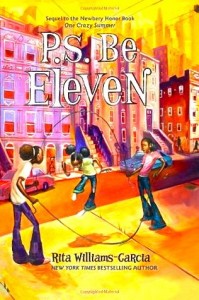
P.S. Be Eleven

10-PS-Be-11The sequel to One Crazy Summer is P.S. Be Eleven. Now back in Bed-Stuy, the girls weave Black Panther lingo into every interaction (“All power to the people!”) and, simultaneously, get swept up in the Jackson Five craze.

They try to make sense of their Uncle Darnell, who returns from Vietnam physically intact but spiritually and psychologically wounded. His sleep interrupted by screaming nightmares, he turns for solace to drugs.

The girls’ father is in love with a woman who campaigns to make Shirley Chisholm the first African-American woman elected to Congress. Big Ma, heartbroken in a hundred different ways, returns to the South.

The book’s title comes from the wild, homemade postcards that arrive from Cecile. She wants Delphine to ease up on feeling responsible for everything and let herself be a child of eleven (even after she turns twelve).

These books are a great way for kids to learn recent American history through the voice of a precocious preteen, and for white adults to hear from a range of black voices about black experience. A whole, vast and varied community comes to life in Williams-Garcia’s able hands. It’s worth the read, especially after the crazy summer we’ve just had.

To Go Deeper:

“12 Things White People Can Do Now Because Ferguson”  by Janee Woods, Quartz, August 17, 2014

“Jane Elliott’s Blue Eyes Brown Eyes Exercise”

“A Class Divided” Frontline 


Jane Elliott — Brown Eyes vs. Blue Eyes (@10 min summary)

“How Do You Identify Racism? The Angry Eye with Jane Elliott” (30 minutes with a college class)

Books

One Crazy Summer by Rita Williams-Garcia, HarperCollins/ 2010

P.S. Be Eleven by Rita Williams-Garcia, Amistad / 2013


Rita Williams Garcia Talks about One Crazy Summer (@ 7 minutes) at Vermont College of Fine Arts

Filed Under: Featured Tagged With: Black Panther Party, Blue Eyes/ Brown Eyes Experiment, Ferguson, Jane Elliott, Janee Woods, One Crazy Summer, P.S. Be Eleven, Rita Williams-Garcia, Shirley Chisholm

It All Began at the Fish Market …

August 20, 2014 By Pam

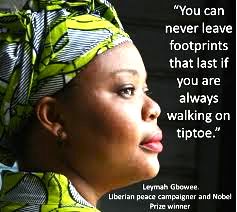
9-GboweeQUOTEThis is not a fairytale. One woman came from a world of talking mice and sleeping beauties, the other from 14 years in the hell of a civil war, with the devil himself on the loose. When Abigail Disney, (Walt’s grandniece) visited Liberia, she was shocked to learn about Leymah Gbowee and the thousands of women who had successfully and nonviolently brought an end a long civil war three years earlier. She hadn’t heard anything about it.
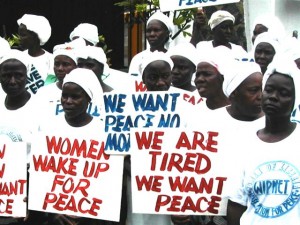
For 14 years, the women of Liberia had held their families together the best they could, while men waged war with rape, terror, and automatic weapons. Over 200,000 died in the war; thousands more wished they had. In the capital city of Monrovia, women, children, and the elderly, forced to flee from their homes, barely managed to survive in camps for the “internally displaced.”

The Women Step Up and Sit Down!

9-LiberianWomenOne day, Leymah Gbowee, a social worker who counseled ex-child soldiers, decided enough was enough. Women had to take on both the warlords and the corrupt regime of President Charles Taylor and demand peace. She turned to the women in her church, asked them to dress all in white, bring a friend, and meet her at the fish market to pray. A call was issued over the radio, and the women showed up. They sat where President Taylor could see them from his office window.

When Assatu Bah Kenneth, a police officer, heard what the Christian women were doing, she mobilized her Muslim sisters, and they, too, went to the fish market.

Through an umbrella organization called Women in Peacebuilding Network (WIPNET), women’s groups had worked tirelessly for a negotiated peace. Now, they came by the hundreds for a sit-in at the fish market. They held up banners, sang, and prayed for peace — Christians and Muslims together. (Photo from Pray the Devil Back to Hell.)

When the violence around them escalated, the women didn’t get discouraged. Instead, they erected an in-your-face billboard which read, “THE WOMEN OF LIBERIA SAY PEACE IS OUR GOAL, PEACE IS WHAT MATTERS, PEACE IS WHAT WE NEED.”

9-Women-WAR-PeaceThey wrote a position statement and marched through the streets of Monrovia to present it to the president and demand a meeting. The women had their first victory on April 23, 2003, when Taylor finally met with a women’s peace contingent, while other women sat outside the office, holding hands and praying. He agreed to attend peace talks in Ghana if the women could find the warlords and get them to come.
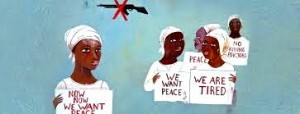
The women sought out the rebel warlords at the hotel where they were meeting in Sierra Leone. They lined the streets and held a sit-in, blocking the hotel doors, demanding to be heard. The warlords realized the women meant business and finally agreed to attend peace talks in Ghana.

Not willing to take anything for granted, the women raised money to travel to Ghana. They were ingenious and relentless in their nonviolent campaign for peace, using a variety of tactics — sit-ins, blockades, a sex strike, singing, prayer, marches and demonstrations, candlelight vigils, a threatened nude action. The women were tired of war. They’d had enough.

Even after a peace agreement was announced and Taylor resigned and went into exile, the women stayed involved. They registered voters, set up polling stations, and helped do the work of rebuilding a nation. On November 23, 2005, the people of Liberia elected Ellen Johnson Sirleaf, the first female head of state in Africa.

A New Kind of Disney Film


When Abigail Disney visited Liberia, she was astonished to hear this remarkable story. Why didn’t the world know about what the women of Liberia had done? She decided to make their victory visible with the tools fate had given her. In an interview with Amy Goodman on “Democracy Now,” Disney recounted a discussion she had with her filmmakers:

We had a conversation as we were making that film about how hard it was to find footage of the women, and it was so striking how absent they were from any discussion of war in general, not just in the news but in the literature and popular culture, and so we decided it was time to make women visible in the landscape of war …

The result was the award-winning 2008 documentary, Pray the Devil Back to Hell. In 2011, Leymah Gbowee and Ellen Johnson Sirleaf shared the Nobel Peace Prize. Abigail Disney went on to make a five-part PBS documentary film series, “Women, War, and Peace,” about courageous women in various “hotspots” around the world. She also founded Peace Is Loud, an organization that inspires action through media focus on women peace-builders.

I love collecting, retelling, and celebrating stories like this one. After a summer of so much suffering and sad news (including the tragic Ebola outbreak in Liberia, while they were still trying to rebuild the broken medical infrastructure after so many years at war), it’s crucial that women’s voices are heard and creativity recognized in doing the hard work of waging peace.

To Go Deeper:

Articles

9-BookCOVER“Liberian Women Act to End Civil War, 2003” on Global Nonviolent Action Database

 Books

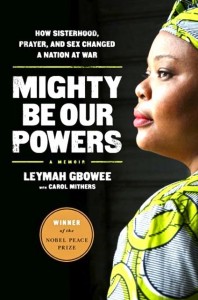
Mighty Be Our Powers: How Sisterhood, Prayer, and Sex Changed a Nation at War by Leymah Gbowee with Carol Mithers

This Child Will Be Great: Memoir of a Remarkable Life by Africa’s First Woman President by Ellen Johnson Sirleaf

9-artArt

 Olaf Hajek Illustrations for film Pray the Devil Back to Hell 

YouTube


Watch this amazing 3 minute clip from Pray the Devil Back to Hell and you’ll want to see more!

For more information and to book the film.

Credits

Photo of Gbowee and Disney by Gabrielle Revere


Filed Under: Featured Tagged With: Abigail Disney, Charles Taylor, Ellen Johnson Sirleaf, Leymah Gbowee, Liberia, Nobel Peace Prize, peace, Pray the Devil Back to Hell, WIPNET, Women in Peacebuilding Network

The “What If” Antidote

August 15, 2014 By Pam

8-Palestinian-womenIt’s been a summer of blood and tears, here, there, and everywhere. The news has been unrelentingly painful — cries of “Don’t shoot!” in our streets, massacres around the globe, Ebola, kidnapped schoolgirls. The suicide of a beloved actor who laughed through his tears set off an avalanche of pent-up feelings on Facebook.

One frustrating aspect of the news has been the apparent lack of female input in ceasefire negotiations. As I understand it, there was not one woman representing either Israel or Gaza in this summer’s talks (not even Tzipi Livni who sits on Israel’s security cabinet), and few if any women at any other peace negotiations. (The photo above was taken in a camp for the “internally displaced” in Iraq.) I’d love to learn that this is inaccurate, believe me.

8-Bush-MenYou’d think, in 2014, men would be embarrassed to so blatantly exclude women. Remember Congressman Darrell Issa’s men-only panel on birth control here in the U.S. just a few years ago? At least the all-male photo-op of Bush signing an abortion bill earned them some bad press.

What If?

What if we reversed this? What if men were excluded from negotiations that involved their lives? Imagine the outrage! Their heads would explode!

It’s not that women are more peaceful. From Margaret Thatcher to Sarah Palin, women can be as misguided as men and their missiles (to paraphrase MLK). And it’s not that women would necessarily do a better job at finding creative, nonviolent ways to resolve our inevitable conflicts — although, wouldn’t it be interesting to find out after thousands of years of mostly male-only decision-making?

In an article published in The Atlantic, “Gaza: It’s a Man’s War,” Elana Maryles Sztokman wrote:

The dearth of women in decision-making positions means that perspectives from 50 percent of the population are largely missing. And it’s not just any 50 percent — it’s the 50 percent who, as a result of their powerlessness, silencing, marginalization, and objectification in times of war, have life experiences that would add tremendous value to the conversation. 

8-Men-ExplainThis in-your-face exclusion of women has made me a pissed-off peacemaker and cranky crone. For solace, I devoured Rebecca Solnit’s slim new book in one sitting. Men Explain Things to Me is the best read of the summer. Her seven essays offer an articulate description of subtle and not-so-subtle ways women are silenced and erased and how this hurts us all (something feminists of all genders know). The title essay went viral in 2008 for good reason (it opens with a scathingly funny anecdote), and “The Longest War” should be required reading, although it will make you weep.

Gynocentric Speculative Fiction

8-PosterThe lop-sidedness of this summer’s male-led rampaging and feeble efforts at mending prompted me to seek literary examples of turning-the-tables for counterbalance.

From Charlotte Perkins Gilman’s Herland (1915) to Marge Piercy’s Woman on the Edge of Time (1976), most utopian visions created by women exalt education, the arts, and safety — a world in which Malala would not be shot in the head for wanting to go to school and the Nigerian schoolgirls would not be kidnapped. In The Female Man, Joanna Russ imagines a world in which a naked woman could walk around the equator twenty times, with one hand on her sex and a large emerald in the other, and all she’ll suffer is “a tired wrist.”

Utopian literature allows us to view the shortcomings of our own time and play with the “what ifs” of a better world. I checked my bookshelves, reaching past the egalitarian stories for a full dose of gynocentric antidote and found three books that did the trick.

8-SultanaIn Lois Waisbrooker’s A Sex Revolution, written in 1893, men agree to change roles with women for fifty years as a social experiment, to see if women can end war.

Sultana’s Dream is a fantasy written in 1905 by Bengali Muslim feminist Rokeya Sakhawat Hossein in which women take charge, shun war, and confine men in a reversal of purdah (the practice of secluding women from public view).

In Sally Miller Gearhart’s 1978 underground classic The Wanderground: Stories of the Hill Women, Earth stops cooperating with males, and women head for the hills to unlearn patriarchy. It’s a painful, magical, and nuanced fantasy with an unresolved ending.

After a few hours immersed in fantasies of women in the lead, my mood improved. I was ready to resume my work for a world where people are encouraged to reach for their best potential as full participants on the planet we share, regardless of gender identity. Spirits lifted, I returned to my research on a chapter about times women have pushed their way into all-male negotiations. Stay tuned …

To Go Deeper:

8-HerlandArticles & essays

“Gaza: It’s a Man’s War” by Elana Maryles Sztokman, The Atlantic, August 7, 2014.

“Studies Show that Including Women in Peace Negotiations Improves Changes of Success” by Eetta Prince-Gibson.

Books

8-Wonder-WomanBarr, Marlene S., ed. Future Females: A Critical Anthology, (Bowling Green State University Popular Press, 1981)

Gearhart, Sally Miller. The Wanderground: Stories of the Hill Women  (Persephone Press, 1978/ Spinsters Ink, 2002)

8-Sex-RevHossain, Rokeya Sakhawat. Sultana’s Dream and Selections from The Secluded Ones (Feminist Press, 1988)

Rohrlich, Ruby and Elaine Hoffman Baruch, eds. Women In Search of Utopia: Mavericks and Mythmakers, (Schocken Books, 1984)

Russ, Joanna. The Female Man (Bantam Books, 1973)

Solnit, Rebecca. Men Explain Things to Me (Haymarket Books, May, 2014)

Waisbrooker, Lois. A Sex Revolution with introduction: “Women in the Lead: Waisbrooker’s Way to Peace” by Pam McAllister (New Society Publishers, 1985)


Mu(sick): Poet Madiha Bhatti, a young Muslim woman, offers a “snap-worthy” rap protesting misogyny and calling for lyrics that empower women and stop polluting the minds of men and boys. Well worth a listen. For video plus the written lyrics go to: http://uncsiren.com/musick/


Credits

Sampler: “Girls Just Wanna Have FUNdamental Rights”

Poster from Attack of the 50 Ft. Woman, 1958 sci-fi movie depicting a cheating husband’s worst nightmare.

Filed Under: Featured Tagged With: Elana Maryles Sztokman, feminist utopias, Joanna Russ, Madiha Bhatti, Men Explain Things to Me, Rebecca Solnit, Sally Miller Gearhart, The Female Man, The Wanderground, utopian literature

“This Work Is our Whole Life”

August 9, 2014 By Pam

7-ShibokusaThis week, I honored the memory of August 1945, when the U.S. dropped atom bombs on Hiroshima and Nagasaki, by writing about the resistance of the Shibokusa women for my new book on creative nonviolence. It lifted my spirits. I hope it lifts yours, too.

Long before Occupy Wall Street, the Shibokusa women of Japan used the tactic of nonviolent occupation. They refused to abandon Mount Fuji, a beloved symbol of their nation.

The land at the foot of Kita Fuji (North Fuji) had been farmed since the Edo period in the 17th century. In 1936, however, it was taken over by the Japanese Imperial Army for military exercises. Following World War II, the base was appropriated by U.S. forces, which retained special privileges even after a 1952 treaty. Little did the soldiers know that some very tough women would become their worst nightmare.

7-FujiAfter most farm families gave up and moved to the cities, these tough, steadfastly antiwar grandmothers formed the Shibokusa Mother’s Committee in 1955, determined to fight for their land and disrupt business-as-usual on the military base. They knew that militarism meant death to people and animals and violence to the earth.



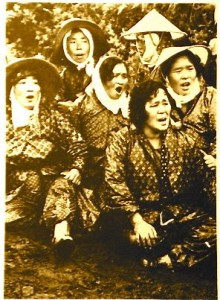
An intentionally mischievous, bothersome, embarrassing presence at the military base, they dressed in baggy trousers and wide straw hats and found countless ways to disrupt training exercises. They flew kites in flight paths, sent up smoke signals to obstruct artillery tests, lay down in the road to block trucks. They created secret paths from their cottages to the military exercise areas and jumped out of the bushes to startle the soldiers. They planted scarecrows, sat in circles to sing and clap, stood pointing and laughing at the men in their military uniforms.

Sometimes, riot police were sent to arrest the women in a futile attempt to evict them and put an end to their resistance. The elders were unfazed.

7-peace-japanese

Humor was one of the hallmarks of the Shibokusa women’s resistance. In an interview with Leonie Caldecott, they explained, “[The police] hate it when we start screaming. They have realized that, though we are physically easier to arrest than men, we’re more trouble afterwards! Men put up a fight, but once it’s over they just give everything away. We never give our name, age or anything. We just say we’re so old, we can’t remember when we were born or who we are.”

In the Caldecott interview, the women said, “Don’t imagine our lives are miserable. It’s fun to make a nuisance of ourselves and embarrass those men. This work is our whole life. We enjoy every minute, but we’re not lazy about it.”

The women’s occupation at Kita Fuji lasted until 2006 when the aged leadership died off, but the stories of their resistance and courage live on.


To Go Deeper: 

7-Book-Cover

Caldecott, Leonie. “At the Foot of the Mountain: The Shibokusa Women of Kita Fuji” from Keeping the Peace: A Women’s Peace Handbook. Lynne Jones, ed. London: Women’s Press, 1983.

“Remembering Hiroshima and Nagasaki with WILPF (Women’s International League for Peace and Freedom), July 28, 2014 http://peaceeconomyproject.org/wordpress/?p=3273

“The Story of the Peace Crane” http://www.buddhistcouncil.org/bodhitree/Books/Story_of_the_Peace_Crane.pdf


 “How to Fold an Origami Crane (for beginners)”


Credits: 

“Origami” by Hiroko Sakai  (She is a contemporary Japanese artist who has lived in San Francisco since 1999.) http://www.redbubble.com/people/hilo/works/3420485-origami


Filed Under: Featured Tagged With: crane, Hiroshima, Japan, Leonie Caldecott, Mount Fuji, Nagasaki, origami, peace crane, Shibokusa

Sleepless in the Cyber Age

August 1, 2014 By Pam

Late last night, I checked my Facebook page once more. Big mistake. Someone had posted the photo of a limp Palestinian toddler, her skull emptied of its contents through a red, raw, gaping hole.

6-psalms_137

“Happy shall they be who take your little ones and dash them against the rock.” (Psalm 137:9)

The Psalmist’s specific revenge was the last thing my eyes saw. I tossed and turned through the night, absent the chance of sweet dreams, and wondered if anyone was “happy” yet and how many “little ones” it would take.

One Night / Seven Themes — from Psalms to Nagasaki

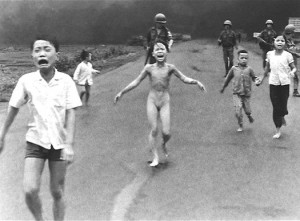
6-Napalm-GirlONE:  “There’s nothing new under the sun.” (Ecclesiastes 1:9). Bashing in baby skulls is a centuries old military tactic. It’s part of war, as is destroying the children’s landscape, families, playmates. In Vietnam, the U.S. did it with bombs, napalm, and Agent Orange. We do it now with drone attacks. And the beat goes on.

TWO:  Why isn’t everyone antiwar?

After eons of experience, we know that violence begets violence. Some of tonight’s weeping survivors are tomorrow’s rage-filled terrorists. Count on it.

Psalm 137 begins with a lament. “By the waters of Babylon, there we sat down and wept when we remembered Zion.” It ends with revenge. Lament – revenge – lament – revenge – lament – revenge …. repeat.

THREE:  It’s a mystery to me why more thinking people don’t embrace the power of nonviolence. Perhaps they truly believe war leads to peace. It’s clear that many are appalled by what they perceive to be slaughter.

6-Imagine-childThere is deep longing for ways to resolve conflict without killing each other. This spring I watched tourists at the John Lennon “Strawberry Fields” memorial in Central Park. I took pictures of people taking pictures. Here’s my favorite. One after the other, they stood on the “Imagine” mosaic. “You may say I’m a dreamer, but I’m not the only one …”

FOUR: I’ve seen the photo of the mangled toddler many times this week. The image is still nauseating, but is it still shocking? I’m not sure. How long does it take to grow accustomed to a mangled face?

6-FarnsworthFIVE: Philo Farnsworth (1906-1971), the Father of Television, thought his invention would bring peace on earth. Seeing the lives of others up close, we’d realize our shared humanity and no longer want to kill one another. Oh well.

SIX: An image of peace — the lion and the lamb together — morphed from a verse in Isaiah. But we’ve grown cynical. Woody Allen cleverly quipped, “The lion will lie down with the lamb, but the lamb won’t get much sleep.”

Young fans of Stephenie Meyer’s Twilight seem to think the lion and lamb originated in a bit of romantic repartee between Edward and Bella. “And so the lion fell in love with the lamb.”  They get this line tattooed on their bodies. Um, it’s not about world peace.

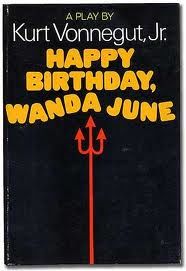
SEVEN: From vampire love, my mind reeled to Kurt Vonnegut’s play, Happy Birthday, Wanda June. Wanda June is a child who speaks to the audience from heaven where Jesus, Hitler, Einstein and Judas play shuffleboard.

One bit of dialogue is between Harold (a Hemingwayesque big game hunter/ soldier) and Looseleaf (who regrets being the “hero” who dropped the bomb on Nagasaki). The passage has been running through my head all week. It comes after Harold has smashed a violin:

                         LOOSELEAF

Anybody who’d drop an atom bomb on
a city has to be pretty dumb.

                         HAROLD

The one direct, decisive,
intelligent act of your life!

                         LOOSELEAF

(shaking his head)
I don’t think so.

                   (pause)

It could have been.

                        6-Vonnegut HAROLD

If what?

                         LOOSELEAF

If I hadn’t done it. If I’d said
to myself, “Screw it. I’m going to
let all those people down there
live.”

                         HAROLD

 They were enemies. We were at war.

                         LOOSELEAF

 Yeah, Jesus — but wars would be a
lot better, I think, if guys would
say to themselves sometimes,
“Jesus — I’m not going to do that to
the enemy. That’s too much.” You
could have been the manufacturer of
that violin there, even though you
don’t know how to make a violin
just by not busting it up.  I could
have been the father of all those
people in Nagasaki, and the mother,
too, just by not dropping the bomb.

                   (pause)

I sent ’em to Heaven instead — and I
don’t think there is one.


6-Wanda-JuneTo Go Deeper:

The Boy Who Invented TV: The Story of Philo Farnsworth by Kathleeen Krull (Knopf, 2009) http://www.goodreads.com/book/show/6400935-the-boy-who-invented-tv

Happy Birthday, Wanda June by Kurt Vonnegut, Jr. (Dell, 1970) http://www.goodreads.com/book/show/1267866.Happy_Birthday_Wanda_June


Credits:

“Napalm Girl” by Associated Press photographer Nick Ut, 1972

Kurt Vonnegut caricature drawn by Kathryn Rathke  www.theispot.com


Filed Under: Featured Tagged With: Happy Birthday Wanda June, John Lennon, Kurt Vonnegut, Philo Farnsworth, Psalm 137, Stephanie Meyer, Strawberry Fields, Twilight series, Vietnam war

The Trouble with History

July 21, 2014 By Pam

“Who built Thebes of the seven gates? In the books you will find the names of kings. Did the kings haul up the lumps of rock?” ~ Bertolt Brecht.

AlamoMy father was a world history teacher in our small town high school. “History” was a common topic at the dinner table and a focus of summer vacations, with family trips to museums and historic sites. (Here I am at the Alamo, age 8, with my Poor Pitiful Pearl doll, grandmother, and big sister.)

My father instilled in me a love of history, but I always saw it from the margins, distrusting the pens of those who recorded events. I dutifully learned the names of kings, queens, and explorers, but, on my own, sought out stories of women and workers, the “masses,” the marchers.

History books and news accounts, of necessity, summarize major actions and their consequences. The named players are flattened, all humanity squeezed out of them, as if they were made of sterner stuff than the rest of us. There is little mention of sweaty palms, nervous stomachs, sleepless nights.

SBA-stamp-2Take Susan B. Anthony, for example. Her stiff image appears on coins and stamps. She famously said, “Failure is impossible!” But she also wrote in a letter to Elizabeth Cady Stanton, “I sometimes fear that I too shall faint by the wayside and drop out of the ranks of the faithful few.”

In 1868, she co-founded a feminist periodical, Revolution, which had as its brazen motto: “Men their rights and nothing more; women their rights and nothing less.” But she also confided privately, “There is so much, mid all that is so hopeful, to discourage and dishearten, and I feel alone.”

SBA-QUOTEIn 1872, she was arrested for attempting to vote in a presidential election, stood trial, and was found guilty. When the judge sentenced her to a $100 fine, she boldly declared, “I shall never pay a dollar of your unjust penalty.” But SBA also confessed in personal correspondence, “I have very weak moments and long to lay my weary head somewhere and nestle my full soul close to that of another in full sympathy.”
Anthony acted, then, despite fear, discouragement, feelings of inadequacy, and aching loneliness.

Ah, here is a woman with whom we can sympathize. These passages breathe life into the dry and distant Susan B. We can relate to a woman who lacked self confidence, grew tired, felt alone. This is familiar territory.

Now, when we read that she committed an act of civil disobedience, we are less inclined to shrug and dismiss her with, “Well, of course. She was the great Susan B. Anthony.”

Instead, we allow ourselves to marvel at her passion and pluck, consistency and courage, and might even go on to imagine, “If Susan B. Anthony could take such an action despite sometimes feeling overwhelmed and insecure, maybe I could risk such activism myself.”


To Go Deeper:

SBA-Museum-2

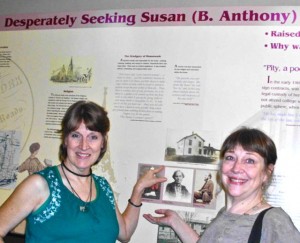
SITES: If you’re in western New York, stop by the Anthony house and take a tour. I went (again) with my sister Lois last summer. It is also possible to take a virtual tour online. National Susan B. Anthony Museum & House (17 Madison Street, Rochester, NY): www.susanbanthonyhouse.org

Afterward, we went down the street to a leafy park to see the statues of SBA having tea with her friend Frederick Douglass (photo). Lois let Douglass whisper in her ear! (see photo) Then we drove a few blocks to the “1872 Café” (www.1872cafe.com), a relaxed and airy sandwich shop located at 431 W. Main Street, across from where SBA was arrested for voting.

Lois-F-Doug-2If you’re in the area, also check out the Women’s Rights National Historical Park in Seneca Falls:  http://www.nps.gov/wori/index.htm

BOOKS: Women of Ideas (And What Men Have Done to Them): From Aphra Behn to Adrienne Rich by Dale Spender (Ark Paperbacks, London, 1982)

Elizabeth Cady Stanton, Susan B. Anthony: Correspondence, Writings, Speeches, edited and with a critical commentary by Ellen Carol DuBois, Foreword by Gerda Lerner (Schocken Books, NY, 1981)


Filed Under: Featured Tagged With: 1872 Cafe, Dale Spender, Elizabeth Cady Stanton, Ellen Carol DuBois, Failure is impossible, Frederick Douglass, Gerda Lerner, National Susan B. Anthony Museum & House, Poor Pitiful Pearl doll, Revolution feminist periodical, Rochester, Seneca Falls NY, Susan B. Anthony, Susan B. Anthony postage stamp, Women’s Rights National Historical Park

  • « Previous Page
  • 1
  • 2
  • 3
  • Next Page »

Pam McAllister

In 1982, I edited the anthology Reweaving the Web of Life: Feminism and Nonviolence and then wrote two books about women’s use of resistance and action: You Can't Kill the Spirit and This River of Courage.

I've spent a lifetime compiling stories of courageous, creative actions, categorizing them (a la Gene Sharp), writing books and articles, speaking at university forums, church retreats, feminist conferences. I’ve also joined in the action -- antiwar protests in the '70s, Take Back the Night marches in the '80s, prison reform rallies in the '90s, and Occupy Wall Street actions in recent years.

I am currently researching more examples of nonviolent action for peace and justice around the world for two new books -- one for/about children and another about women (whose actions are still so often left out or overlooked).

Here I am with Barbara Deming, my mentor and friend, in Sugarloaf Key in the early ‘80s. The photo has faded, but the memories and love have not.

Connect With Pam Online

  • Facebook
  • Twitter
Your Comments: I’m new at blogging. After I've had some time to learn how to do this, I will have a way for you to leave comments and be in dialogue with me. My Author's Guild website is at: http://pammcallisterauthor.com. Also, see my Facebook Author Page Global Nonviolence: Stories of Creative Action and My Amazon "Author Page".

FOR EMAIL NOTICES

Sign up to be notified of new blog posts!
STEP 1: Enter info below
STEP 2: Click on purple bar
STEP 3: Then, an email will ask you to confirm this.
~ You're all set! ~

Search Site

Copyright © 2014, Pam McAllister

Copyright © 2026, Activists With Attitude · Log in