Grand Central Terminal die-in, 12/3/14 (Daily Mail, U.K., EPA photo)
“I was in a die-in!”
One of my teenaged piano students bubbled over with news of everything happening at her high school last week, beginning with teacher-led discussions about racism, grand juries, the criminal justice system, last century’s Civil Rights movement. Classroom lessons inspired some students to stage a die-in.
“What was that like for you?” I asked. She told me that she thought about Mike Brown and Eric Garner while she lay beside her classmates in the school lobby.
“What did your friends say about it?” Most felt good about the protest, she thought. The only disagreement was about whether or not it was disrespectful to sit up and take a “selfie” in the middle of the action. Some said yes, some said no. Hmmm, I didn’t know what to say about activism etiquette in the Digital Age.
VARIATIONS ON A TACTIC:
FROM BREASTFEED-INS TO WADE-INS

St. Louis die-in with body outlines, 11/16/14, photo by Joe Raedie (Getty)
As luck would have it, I’ve been working on a chapter of my book (on women’s nonviolent actions) about experiments with physical intervention, a form of nonviolent direct action — specifically sit-ins and their variations: breastfeed-ins, die-ins, dance-ins, glitter-ins, howl-ins, kiss-ins, pray-ins, pee-ins, sleep-ins, read-ins, wade-ins. The actions themselves might be risky for those taking part, but the variations are endlessly creative and make this chapter fun to write! I’ll share more about these in future blog posts. Stay tuned.
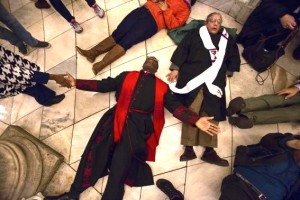
Faith leaders from New York Theological Seminary, 12/8/14 die-in at NY City Hall, photo by Andrew Kelly (Reuters)
The tactic of disrupting business-as-usual with physical intervention reminds me of the old protest song “It Isn’t Nice” by Malvina Reynolds, made popular by Judy Collins. (See YouTube clip below.) The refrain notes that blocking doorways “isn’t nice” and concludes, “but if that’s freedom’s price, we don’t mind.”
According to nonviolence scholar Gene Sharp, sit-ins date back to the mid-1800s when the tactic was used by antislavery activists challenging publicly segregated spaces. It was picked up by Native Americans in the 1930s. In the 1940s, the tactic was tried by members of CORE (Congress of Racial Equality) in Chicago. Later, lunch counter sit-ins were used extensively during the 1960s Civil Rights movement.

Die-in by staff of the Center for Constitutional Rights, 12/17/14, part of a citywide 7 minute collective “Die-in/ Rise up” action to mark the 5 month anniversary of the killing of Eric Garner
Die-ins are a more recent variation. One of the earliest took place on the first Earth Day, April 22, 1970, when Harvard Ecology Action sponsored a die-in at Logan International Airport to protest environmental pollution. In May 1970, 150 demonstrators staged a silent “die-in” in Seattle to protest the shipping of nerve gas through Washington state. In 1981, on International Women’s Day, 3,000 women in Ramstien, West Germany lay down in front of a NATO airbase to simulate the effect of a nuclear attack.
Last year, inspired by a massive cyclists’ die-in in Amsterdam in the 1970s, 1,000 cyclists staged a die-in in London to call attention to the need for improved road safety. They were asked “to lie on the pavement with your bicycles, turn on your lights and let them flash in the memories of people killed and injured in the last eight years.”
DIE-INS: THE TACTIC DU JOUR

Students at Washington University, die-in, 12/1/14, photo by Larry W. Smith (EPA)
In the wake of the police killings of two unarmed black men, Mike Brown in Ferguson and Eric Garner in Staten Island, die-ins have proliferated as a tactic. Some have been timed to last 4 1/2 minutes, symbolic of the 4 1/2 hours Brown’s body was left in the street, untended.
Visual and therefore deemed newsworthy, die-ins help sustain media attention and effectively disrupt business-as-usual.

Harvard medical students participate in nationwide “White Coat Die-in” 12/10/14, photo by David L. Ryan
In recent days, lawyers in suits and ties chanted “Black lives matter” and “I Can’t Breathe” from pavements in front of courthouses across the nation. Medical students at over forty colleges staged a well-organized “White Coat Die-In.” Legislators, teachers, and clergy have laid down in solidarity.
In libraries, shopping malls, bridges, streets, in quiet towns and hectic cities, across the U.S. and in places around the world, on cold pavements and on the well-trod floors of major traffic hubs like Grand Central Station — everywhere these days, budding activists and seasoned protesters are lying down for a cause. When they stand up again, they often feel a new sense of empowerment.
A NEW YEAR’S WISH

Dance-in on missile silo at Greenham Common, 1/1/83, photo by Raissa Page
At dawn, on New Year’s Day, in 1983, at Greenham Common women’s peace encampment in England, forty-four women crept through the frosty early light, propped a ladder against the fence protecting nuclear silos, threw blankets over the razor-wire, and dropped a second ladder down the other side, then scrambled over the top, one after the other, hearts pounding.
When they’d made it over, they rushed, all together, holding hands, up the mud slopes to the top of a silo which housed U.S.-owned weapons intended for World War III. Before the police closed in, they formed a circle and danced, sang, and cheered. They held up a sign, “PEACE 83” for the TV reporters who had been alerted to the “dance-in.” The iconic image of women dancing on the nuclear silo, silhouetted against the dawn of a new day, inspired and sustained many in the women’s peace movement throughout the 1980s.
I offer this image of an earlier New Year’s Day action to inspire us all not to give in to world-weary resignation in the face of so much suffering and wrong, but to greet 2015 with a renewed commitment to fight the good fight — together. Happy New Year, everyone!
TO GO DEEPER

Black Friday die-in at Galleria Mall, St. Louis, photo by Ruth Fremson, (NYT)
“The Methods of Nonviolent Intervention” in The Politics of Nonviolent Action: Part Two, The Methods of Nonviolent Action by Gene Sharp, 1973.
“A Brief History of Die-Ins, the Iconic Protests for Eric Garner and Michael Brown” by Marina Koren, in the National Journal, December 4, 2014.
Local news report of the “White Coat Die-In” at the University of Tennessee Health Science Center, December 10, 2014.
Judy Collins sings “It Isn’t Nice” by Malvina Reynolds

 “White privilege” means never having to say you noticed — never noticed landlords who refuse to rent, banks that refuse to lend, employers who won’t employ, taxis that refuse to stop, never noticed the pain caused by racial slurs and jokes, never noticed the lack of parks or after-school programs in minority neighborhoods, never noticed store personnel following black customers, never noticed the “school-to-prison-pipeline” with black students less likely to be assigned experienced teachers and well-equipped classrooms, more likely to be suspended or expelled for misbehavior, never noticed commuters pulled over for “driving while black,” police brutality disproportionately born by African-Americans, prisons bursting at the seams with black and brown people …
 In 1997, I was disheartened by apparent white apathy after the police brutalization of Abner Louima. I went to a Brooklyn rally (photo) and could count the white protesters on one pale hand. History has brought us to a new day, when people of all races, classes, beliefs are coming together in rage, despair, and hope.
 “White privilege” means treating the killings of Mike Brown and Eric Garner as unfortunate “incidents,” denying the long history of institutional racism and the systemic targeting of people of color. It means saying, in condescending tone, “Well, really, all lives matter, don’t they?” or derailing deep conversation with the truism “But not all cops are bad,” (reminiscent of the meme “not all men” as rebuttal to outrage about rape and battery), or insisting that people of color stop what they are doing to educate white folks about our shared history.
 Violence against black and brown peoples has been relentless from the start. It’s been “status quo” and “the way things are.” People of color silently mourned or seethed, while the white majority barely noticed. In our silence we acquiesced.
 Police over-reaction in Ferguson revealed something many of us (myself included) had not known: the Defense Department has been arming local police with surplus equipment since 1997 — tanks, full battle gear, tear gas. Now, at last, we’re talking about the “militarization of America’s police.” That we’re talking about it is a good thing.
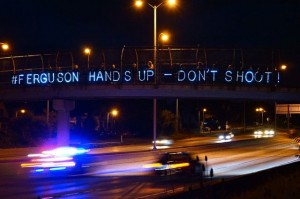 But this time, nothing is stopping creative protest — not media distortion, not chilly winds, rain, snow, not even Christmas. Has the world ever seen anything quite like this?
 In Milwaukee, the Overpass Light Brigade created a digital sign on a pedestrian overpass bridge. Medical students held “white coat die-ins” at Yale, Tulane, Johns Hopkins, and several dozen other schools.
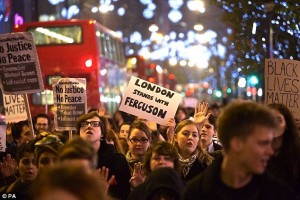 “Which Side Are You On?” was also sung by protesters at the St. Louis Symphony. Diverse in race, age, and gender, they bought tickets, stood up mid-concert, sang a “Requiem for Mike Brown,” and left of their own accord, as they tossed confetti hearts and unfurled banners from the balcony. Some on stage and in the audience applauded, others booed or sat open-mouthed.
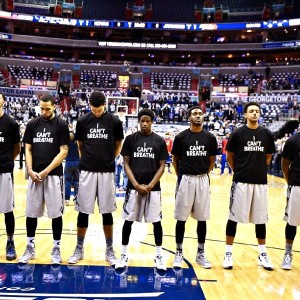 People of faith are holding vigils, die-ins, prayer meetings, and rallies. They’re hosting after-church racism discussions.
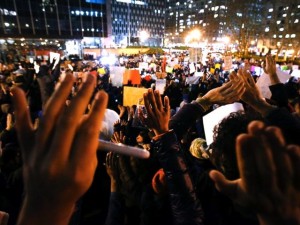 Many thousands of protesters are expected to flood Washington, D.C. this weekend for the March Against Police Violence. There’s a whole new anti-racism movement on the move now, led by young people who are both informed and savvy about how to use the new technology.