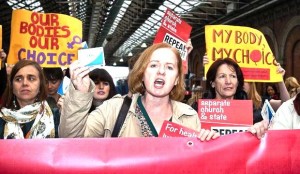
 In 1971, no one could have imagined that Ireland would have a pro-contraceptive female president (Mary Robinson) by 1990, or that she would be succeeded by another female president in 1997 (Mary McAleese).
At the time, divorce was constitutionally prohibited. Husbands were the legal heads of their households. Ireland still outlawed contraception, not to mention abortion. In the fight for women’s rights, challenging the ban on birth control seemed a good place to begin.
The plan was for several women to cross the border to Northern Ireland, buy contraceptives in a pharmacy, and smuggle them back into Ireland. They hoped to grab headlines by allowing themselves to be caught, arrested with the contraband, and hauled off to jail.
On May 22, a small group took a train to Belfast and headed for the nearest drugstore. Born and raised Catholic, their understanding of birth control was sorely limited. When they boldly demanded coils, loops, and birth control pills, the pharmacist coolly explained that medical consultation was required for those forms of birth control. The women had to settle for condoms, creams, and jellies. They also bought lots of aspirin.
 Back in Dublin, they were met by customs officials and cops. As onlookers gaped, the women waved tubes of contraceptive creams and jellies over their heads and read aloud from an article on birth control they’d clipped from a magazine. Then, for dramatic effect, they scattered what they hoped looked like birth control pills (the aspirin) on the floor. The condoms, however, they kept for themselves.
With national and international television reporters in tow, the women marched to a police station. The cops, however, played it cool and refused to arrest the women, thus minimizing headlines. Two days later, the Prime Minister assured members of parliament that the contraceptives had been confiscated and all was well.
SPARKING DEBATE, DISLODGING A BOULDER
Despite the lackluster response by authorities, the Pill Train action sparked debate, an essential tool of any nonviolent revolution.
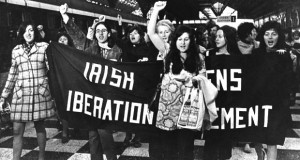 Throughout the next decade, a number of bills concerning birth control were debated and voted on, allowing small concessions here and there. The Health Act, passed in 1985 and amended several times, went a long way toward making contraceptives available in Ireland. Censorship laws were reformed to allow mention of family planning.
The 8th Amendment to Ireland’s Constitution (1983), however, criminalized abortion, even when the pregnancy is forced by rape or incest and or when carrying the fetus to term is a threat to the woman’s mental or physical health. The only exception is for a risk (narrowly defined) to the actual life of the woman. Ireland ranks with Afghanistan, Chile, and Somalia when it comes to attitudes about a woman’s right to control her own body.
SAVITA’S DEATH
 In October, 2012, Savita Halappanavar, a 31-year-old married dentist, began to miscarry due to a bacterial infection. At the University Hospital Galway, she begged for a medical abortion, but, since the fetus still had a heartbeat, she was denied one. According to one report, an assisting doctor, when asked why they couldn’t intervene, said, “You are not dying enough.”
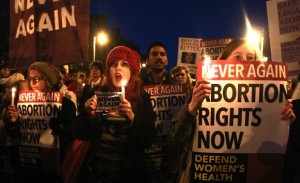
By the time the fetal remains were removed from her body, Savita was in septic shock. She died a few days later with her husband by her side. News spread through social media outlets. Tens of thousands mourned and protested at rallies and vigils in Ireland, England, and India.
2014 “ABORTION PILL TRAIN”
 Two years later, on October 28, 2014, while candlelight vigils were held across Ireland in Savita’s memory, a small group of pro-choice activists again boarded a train in Dublin and headed to Belfast.
They returned with “abortion pills” ordered through WoW (Women on Web), an online organization that assists women seeking safe abortions.
Participants from groups including Action for Choice and ROSA (Reproductive rights, against Oppression, Sexism & Austerity) rode the train and explained their actions to the media. In the train station, ten women swallowed some of the pills to demonstrate their safety, an act of civil disobedience. Once again, the police looked the other way.
✔ MARRIAGE, ✘ REPRODUCTIVE RIGHTS
On May 22, 2015, the Republic of Ireland became the first nation in the world to legalize same-sex marriage, not by an act of legislation, but by popular vote. It was celebrated as a remarkable shift in public opinion because homosexuality was only decriminalized in 1993.
 Why are LGBTQ rights, especially those which expand and strengthen the institution of marriage, winning in Ireland (and the U.S.), while women’s reproductive rights are so severely lagging?
Feminist author Katha Pollitt has some ideas. Marriage, she says, is about love, commitment, and settling down. People of all genders, classes, and sexual identities are invested in it as a right.
Reproductive rights, on the other hand, have to do with sexual activity, sexual freedom, and women’s control of their own bodies. As Pollitt explains, it’s about replacing “the image of women as chaste, self-sacrificing mothers dependent on men with that of women as independent, sexual, and maybe not so self-sacrificing.” For some, the debate pits the pure potential of fetuses against the complicated lives of grown women. Fetuses are considered innocent; women are not.
The struggle continues.
TO GO DEEPER
Books:
 This River of Courage: Generations of Women’s Resistance and Action by Pam McAllister, New Society Publishers, 1991
“IRELAND(S): Coping with the Womb and the Border,” by Nell McCafferty in Sisterhood Is Global: The International Women’s Movement Anthology, edited by Robin Morgan, Anchor Press/ Doubleday 1984.
Articles:
“Law, Disobedience, and ‘the Abortion Pill’” by Mairead Enright, Human Rights in Ireland, Nov. 1, 2014.
“International Women’s Day 2015: The Continued Struggle for Reproductive Rights in Ireland” by Irish Forum for Global Health, Global Health Writes, March 5, 2015
“Pregnant Woman’s Death Sparks Abortion Debate In Ireland” by Krishnadev Calamur, NPR.org, November 15, 2012
“The Future of Abortion Is Here — No Clinic Needed” (about Women on Web) by Allegra Kirkland, AlterNet, August 29, 2014.
“There’s a Reason Gay Marriage Is Winning, While Abortion Rights Are Losing” by Katha Pollitt, The Nation, April 22, 2015
Video Clip:
“Prochoice activists bring illegal Abortion Pills into Ireland, 28th October 2014” (2:05 mins)
 This happened in McKinney, Texas on Friday, June 5, 2015. Once again, cellphone activism was used to alert the nation. The video went viral. By that Sunday, Officer Eric Casebolt was off the job. Some commentators said he was a “bad apple.” Others said was a good cop having a very bad day. Both miss the point. This is not about a lone officer’s failure to do the “right” thing or even the “helpful” thing. It’s about us.


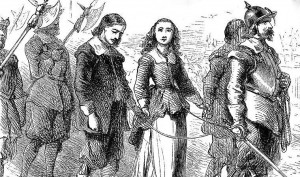 Puritan fathers, lips stiff as church pews, arrived in the New World with worthy dreams. They would build a shining city on the hill, a New Jerusalem of parks, libraries, and schools, and tend lovingly to the poor and ill.
 On October 27, the three Quakers walked hand-in-hand to the Hanging Elm, Mary in the middle. They tried to address the crowd, but drummers had been ordered to maintain a steady beat and drown out their voices.
 Mary Dyer waited out the long winter on Shelter Island, no doubt grieving the friends she’d watched die before her. And then one day in May, she returned to Boston clothed, as it were, in disobedience, once again defying the law of “Quaker banishment.”