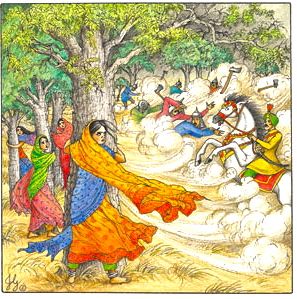
 As we prepare for the People’s Climate March on September 21 here in NYC, I am thinking about some of the brave women who have fought valiantly for the Earth, like the heroines of the Chipko (“tree-hugging”) movement in India.
In 1730, Amrita Devi watched men with axes enter her village with an order from the Maharajah — to cut down trees needed to build his new palace.
The trees were the villagers’ source of life, the only green in an otherwise barren landscape. The forest shielded the people from the desert, protected their fragile water supply, provided fodder for the cows and twigs for the fire. What’s more, the trees and animals were sacred and not to be harmed, according to the rules of their Hindu sect.
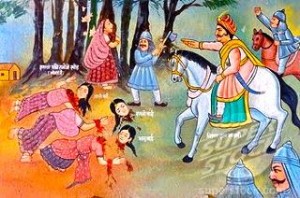 Amrita Devi tried to reason with the men, but they had their orders. They entered the forest with axes raised. Amrita Devi boldly walked past the bewildered men and stretched her thin arms around a tree saying, “If a tree is saved, even at the cost of one’s head, it is worth it.”
What is the life of a peasant woman to men who are bound to obey the orders of a Maharajah? Amrita Devi was beheaded protecting the trees. When her three daughters stepped up to take her place, they, too, were beheaded. It is said that 363 villagers were killed that day, trying to save the sacred trees that were essential to their lives.
When the Maharajah heard about the massacre, he was appalled at the loss of life. As the story is told, he declared a permanent injunction against felling the trees or killing the wildlife in the area of the massacre and exempted the villages of that region from land taxes. Today, the Bishnoi villages of Jodhpur are a tourist attraction, green and beautiful, filled with animals and birds, in an otherwise desolate region. Amrita Devi is honored as one of the world’s first eco-warriors.
Chipko Movement Reborn in the 1970s
 In modern times, developers descended on the forests of the Himalayas seeking short-term profit. Deforestation led to environmental disasters. In monsoon season, landslides and floods devastated the regions where trees once secured the land.
 One day in March, 1974, when the men of Reni were away, laborers with axes and guns showed up with government permits to fell the trees. A little girl saw them and raced to get Gaura Devi (photo) who quickly alerted 27 other women. Together, they marched to the forest and confronted the men.
Gaura Devi (1925-1991) was unschooled, but wise. She said, “Brothers, this forest is like our mother. You will have to shoot me before you can cut it down.” The men laughed.
Dodging obscenities and threats, the women stood between the men and the trees until the workers, frustrated and exhausted, backed down. It took months of vigilance and protest, but, using Gandhian nonviolence, the people, with women in the lead, saved their trees.
 The rural Chipko movement has been an inspiration to ecology activists around the globe. In 2008, twig sculptures of the tree-hugging women created by Klub Gaja, a Polish environmentalist group, greeted delegates at the entrance to the UN’s climate change conference in Poznan, Poland.
How can I, a woman living in 21st century NYC, understand this story? If I’m thirsty, I turn the tap, and clear, drinkable water comes out. If I want to cook my dinner, I turn another knob and a small, controllable ring of fire appears on my stovetop. I can’t imagine using 85% of my time walking to get water or firewood.
But then, I remember what is happening to the water in Detroit, the rainforest in Brazil, the mountaintops in West Virginia. I’d better understand. See you at the People’s Climate March on the 21st!
To Go Deeper
Articles:
“The Original Tree Huggers: Let Us Not Forget Their Sacrifice on Earth Day” by Rucha Chitnis, April 22, 2013, from Women’s Earth Alliance (An excellent article, with information from Amrita Devi’s day to current history)
“Lessons from the Mountains” by C.S. Lakshmi in The Hindu, May 21, 2000
 Books:
Aani and the Tree Huggers by Jeannine Atkins (award-winning children’s book about the 1970s Chipko movement)
The Legend of Gaura Devi: The Eco-Warrior of India by Aditya Pundir, Parth Joshi, and Bhavna Pundir (available only on Kindle)
Anand, Anita. “Saving Trees, Saving Lives: Third World Women and the Issue of Survival” in Reclaim the Earth: Women Speak Out for Life on Earth, Leonie Caldecott and Stephanie Leland, Eds. London: The Women’s Press, 1983
Videos:
The Original Conservationists: Bishnois of Rajasthan (5:30 mins.)
Chipko Movement (1:30 cartoon for children)
A Day in History, Chipko Movement (of 1974) 2 mins.
The Oldest Tree Huggers (5:47 mins.)
Credits:
Photo: Student members of the National Green Corps commemorate the Chipko movement on the UN’s International Biological Diversity Day in June, 2012
Illustration of Amrita Devi by Jillian Gilliland.



 This is not a fairytale. One woman came from a world of talking mice and sleeping beauties, the other from 14 years in the hell of a civil war, with the devil himself on the loose. When Abigail Disney, (Walt’s grandniece) visited Liberia, she was shocked to learn about Leymah Gbowee and the thousands of women who had successfully and nonviolently brought an end a long civil war three years earlier. She hadn’t heard anything about it.
 One day, Leymah Gbowee, a social worker who counseled ex-child soldiers, decided enough was enough. Women had to take on both the warlords and the corrupt regime of President Charles Taylor and demand peace. She turned to the women in her church, asked them to dress all in white, bring a friend, and meet her at the fish market to pray. A call was issued over the radio, and the women showed up. They sat where President Taylor could see them from his office window.
 They wrote a position statement and marched through the streets of Monrovia to present it to the president and demand a meeting. The women had their first victory on April 23, 2003, when Taylor finally met with a women’s peace contingent, while other women sat outside the office, holding hands and praying. He agreed to attend peace talks in Ghana if the women could find the warlords and get them to come.

 It’s been a summer of blood and tears, here, there, and everywhere. The news has been unrelentingly painful — cries of “Don’t shoot!” in our streets, massacres around the globe, Ebola, kidnapped schoolgirls. The suicide of a beloved actor who laughed through his tears set off an avalanche of pent-up feelings on Facebook.
 You’d think, in 2014, men would be embarrassed to so blatantly exclude women. Remember Congressman Darrell Issa’s men-only panel on birth control here in the U.S. just a few years ago? At least the all-male photo-op of Bush signing an abortion bill earned them some bad press.
 This in-your-face exclusion of women has made me a pissed-off peacemaker and cranky crone. For solace, I devoured Rebecca Solnit’s slim new book in one sitting. Men Explain Things to Me is the best read of the summer. Her seven essays offer an articulate description of subtle and not-so-subtle ways women are silenced and erased and how this hurts us all (something feminists of all genders know). The title essay went viral in 2008 for good reason (it opens with a scathingly funny anecdote), and “The Longest War” should be required reading, although it will make you weep.
 The lop-sidedness of this summer’s male-led rampaging and feeble efforts at mending prompted me to seek literary examples of turning-the-tables for counterbalance.
 In Lois Waisbrooker’s A Sex Revolution, written in 1893, men agree to change roles with women for fifty years as a social experiment, to see if women can end war.
 Articles & essays
 Barr, Marlene S., ed.
  Hossain, Rokeya Sakhawat.
 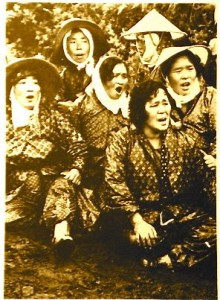 This week, I honored the memory of August 1945, when the U.S. dropped atom bombs on Hiroshima and Nagasaki, by writing about the resistance of the Shibokusa women for my new book on creative nonviolence. It lifted my spirits. I hope it lifts yours, too.
 After most farm families gave up and moved to the cities, these tough, steadfastly antiwar grandmothers formed the Shibokusa Mother’s Committee in 1955, determined to fight for their land and disrupt business-as-usual on the military base. They knew that militarism meant death to people and animals and violence to the earth.


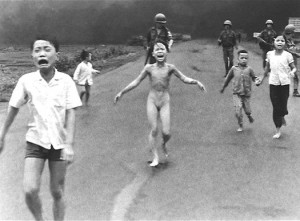 ONE: “There’s nothing new under the sun.” (Ecclesiastes 1:9). Bashing in baby skulls is a centuries old military tactic. It’s part of war, as is destroying the children’s landscape, families, playmates. In Vietnam, the U.S. did it with bombs, napalm, and Agent Orange. We do it now with drone attacks. And the beat goes on.
 There is deep longing for ways to resolve conflict without killing each other. This spring I watched tourists at the John Lennon “Strawberry Fields” memorial in Central Park. I took pictures of people taking pictures. Here’s my favorite. One after the other, they stood on the “Imagine” mosaic. “You may say I’m a dreamer, but I’m not the only one …”
 FIVE: Philo Farnsworth (1906-1971), the Father of Television, thought his invention would bring peace on earth. Seeing the lives of others up close, we’d realize our shared humanity and no longer want to kill one another. Oh well.
 HAROLD
 To Go Deeper:
 My father was a world history teacher in our small town high school. “History” was a common topic at the dinner table and a focus of summer vacations, with family trips to museums and historic sites. (Here I am at the Alamo, age 8, with my Poor Pitiful Pearl doll, grandmother, and big sister.)
 Take Susan B. Anthony, for example. Her stiff image appears on coins and stamps. She famously said, “Failure is impossible!” But she also wrote in a letter to Elizabeth Cady Stanton, “I sometimes fear that I too shall faint by the wayside and drop out of the ranks of the faithful few.”
 In 1872, she was arrested for attempting to vote in a presidential election, stood trial, and was found guilty. When the judge sentenced her to a $100 fine, she boldly declared, “I shall never pay a dollar of your unjust penalty.” But SBA also confessed in personal correspondence, “I have very weak moments and long to lay my weary head somewhere and nestle my full soul close to that of another in full sympathy.”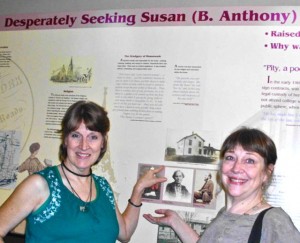
 If you’re in the area, also check out the Women’s Rights National Historical Park in Seneca Falls:
 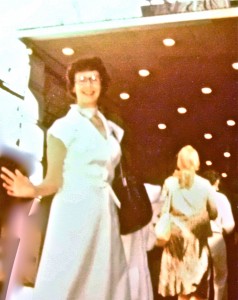 Magicians and scientists know that what we expect to see affects what we will see. Every time my parents visited me in NYC, I experienced this firsthand.
 Decades earlier, another greeting had a profound effect on people. Within weeks of the Nazi’s rise to power, the “Heil Hitler” salute was made mandatory. It became the normal greeting on the street, at work, in school. People had “Hitler” on their lips and in their heads all day long.
 The teacher looked the other way until the day an authority came to observe the class. That day, with everyone watching, Zassenhaus stood when the class stood. When they raised their arms, so did she — but she deliberately thrust her arm through a window by her desk and had to be rushed to the hospital. Her defiant gesture was a metaphor for bloodshed to come.
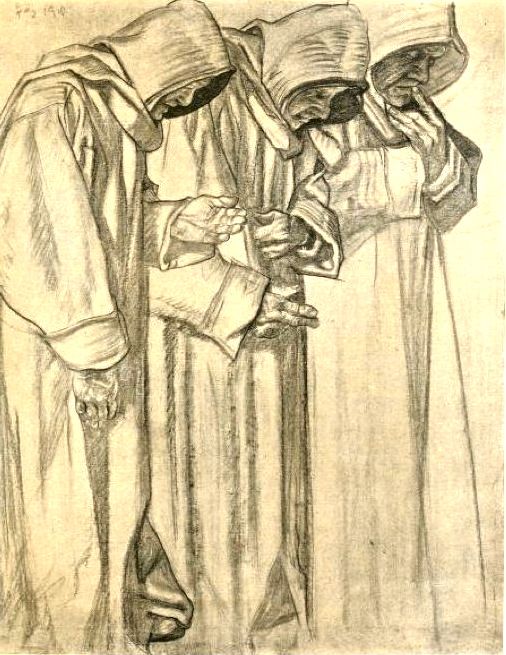 The sage shook his head. “I’m sorry to hear this, my friend, and a bit surprised. You see, rumor has it that the Messiah is one of you.”
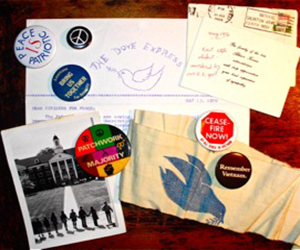 I made a promise forty-four years ago, that the spirit of Allison Beth Krause would live on in my heart.
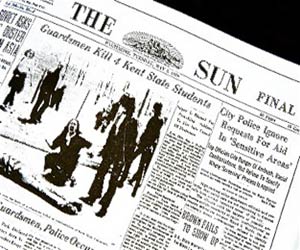 I remember, as if in a dream, how word of the Kent State killings spread across the little college campus in the middle of Pennsylvania, where I, too, was a politically-involved, bright-eyed freshman. In my memory of that soft dusk, we all seemed to be running and whispering, whispering, whispering the news. I remember the shock. I remember thinking, “This is real! This is real! It could have been me. It could have been me.”
 One was my week visiting radical feminist pacifist Barbara Deming and her partner Jane Gapen in the Florida Keys. I’d read Barbara’s books in college (Revolution and Equilibrium and Prison Notes). Most of my understanding of nonviolence was a direct result of her writing. She eventually became my mentor. Through her, I came to understand the vital link between feminism and nonviolence.Mornings at Sugarloaf Key were spent reading, bike riding, and exploring the tropical landscape, while Jane worked in her art studio and Barbara wrote, slowly pecking out an occasional sentence on her typewriter.
 Two days after I left the Keys, I visited a women’s collective in northern Florida. These women slept with pistols beneath their pillows, prepared to use guns for self defense.