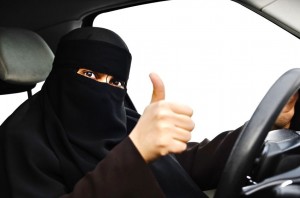
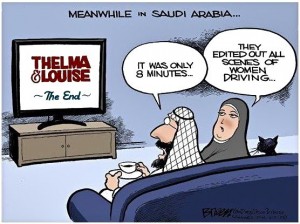
 Last week, two Saudi Arabian women were finally let out of jail. The crime for which they’d been imprisoned? — driving-while-female.
FREEDOM TOOLS: CAR KEYS AND COMPUTER SKILLS
On November 30, 2014, Loujain al-Hathloul, a 25-year-old Saudi women’s rights activist, made a 19-second video of herself behind the wheel in the United Arab Emirates (UAE), where she had obtained a legal driver’s license. She was stopped when she attempted to drive across the border into Saudi Arabia.
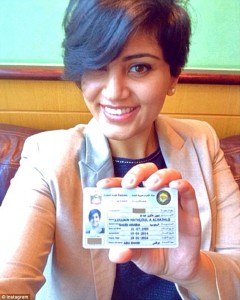
Hathloul with her UAE driver’s license
Guards confiscated Hathloul’s passport and forced her to remain in her car overnight on the UAE side of the border. She communicated with friends that she was cold, tired, and hungry. When television journalist Maysa al-Amoudi came to her aid, she, too, was detained. Eventually, both women were ordered to drive their cars through the checkpoint, into Saudi Arabia, and pull over. When they did, they were arrested and taken to the Bureau of Interrogation and Prosecution in the city of Hofuf.
The women were held for two months in separate detention facilities. Their case was turned over to a special tribunal on “terrorism,” which examined the women’s extensive use of social media. Hathloul had over 232,000 followers on Twitter, and her husband, Fahad Albutairi, a popular comedian, rallied support of his 1.6 million Twitter fans. His satirical music video, “No Woman, No Drive,” (see below), a take-off on Bob Marley’s “No Woman, No Cry,” was a favorite rebuke to Muslim clerics, who maintain that driving would damage a woman’s ovaries.
The release of Hathloul and Amoudi came shortly after Prince Charles met with Saudi Arabia’s newly crowned King Salman. It is not yet clear what conditions were placed on their release or whether there are charges pending.
25 YEARS IN THE STRUGGLE
 Women in Saudi Arabia have a high rate of literacy, are afforded access to advanced education, use social media more than their sisters in the U.S., and are respected in their professional work as doctors, teachers, and businesswomen.
On the other hand, they continue to live under a system of male guardianship.
Considered a key ally by the U.S., Saudi Arabia consistently ranks at the bottom of the list of nations for women’s rights and is the only nation on earth to deny women the right to drive. There are no specific laws prohibiting women from driving, but a religious edict denies the issuing of licenses to women. Moreover, the monarchy bans public protest.
 1990: In Riyadh, on November 6, 1990, after seeing American women GI’s driving, almost 50 prominent Saudi women took to the wheel in defiance of the prohibition. Many were professors or businesswomen. They knew they would be stopped and reprimanded, but believed that their protest was an important step in raising public awareness. After their action, some were called whores. Others received death threats. Their passports were confiscated. Several lost their jobs or were denied promotions.
2005: Fifteen years later, they held a reunion and wore T-shirts stamped “NOV. 6, 1990.” The women were encouraged because Mohammad al-Zulfa, a retired history professor and member of the Shura Council, had proposed a study of the pros and cons of allowing women to drive. He’d told the press, “There’s nothing in our religion or society that bans women from driving. Women drove camels during the time of the Prophet and if he were around today his wives would be driving.”
 2007: At a World Economic Forum press conference, Princess Lolwah Al-Faisal made headlines when she said women should be allowed to drive. This was the first time a member of the royal family had made such a statement.
Though her statement received hearty applause in Switzerland, it failed to persuade the many Saudi women back home who staunchly support the driving ban. They believe that driving is a symbol of Westernization, and would be a loss of status and privilege and a step toward women’s moral corruption.
Saudi driving activists counter those claims, pointing out the economic considerations: not all women can afford to hire drivers (it can cost up to a third of a woman’s salary), and waiting for a male relative to drive them is inconvenient. Further, the right to obtain a license and get behind the wheel is symbolic of the larger issues of women’s empowerment and equality, not only freedom of movement.
To complicate matters, driving restrictions do not apply to some Bedouin women. They live in remote areas where traffic police are scarce and have been driving for years. When Bedouin women encounter problems for driving, it is rarely a legal matter but one of sexual harassment.
 2011: The “Saudi Women’s Driving Initiative” was announced for June 17, 2011. To generate support for that action, Manal Al-Sharif, in headscarf and black abaya, posted a videotape of herself driving on You-Tube and Facebook (see below). She had 600,000 views in just days.
She started a campaign called “Women2Drive.” Al-Sharif not only received death threats, but an unnamed source notified news outlets that she had died in a car crash. It wasn’t true.
 The day of action raised the level of debate in Saudi Arabia and generated global support. Women in other countries videotaped themselves driving and posted their clips on the “Honk for Saudi Women” YouTube channel.
Shaima Jastaniah was one of the women arrested for an act of civil disobedience in 2011. She had learned to drive while studying in the United States and considered it a basic human right in modern times. She also believed that the prohibition had nothing to do with Islam and everything to do with patriarchal rule and control.
Several months after her arrest for driving, she was sentenced to be lashed for her crime. Her lawyers filed a petition for pardon. Jastaniah’s case became an international cause célèbre when The Atlantic published an article about her plight. She was pardoned and spared the whip, but she was also taken in for fingerprinting by the Jeddah Police Department and warned that next time she would be flogged.
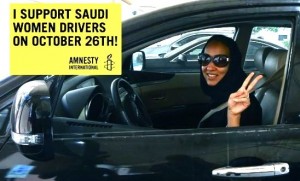 2013: On October 26, 2013, approximately 60 women took to the wheel in Riyadh, Jeddah, and al-Ahsa, armed with licenses from other countries. Supportive friends video-documented their acts of civil disobedience.
Several women reported thumbs-up encouragement from male drivers, but others were stopped by the police and told to wait in their cars for male relatives to drive them home. Over 16,600 signatures in an online petition were compiled in a well-organized social media campaign for a lifting of the ban in Saudi Arabia, where Twitter has millions of users.
THE QUEEN’S SURREPTITIOUS SOLIDARITY
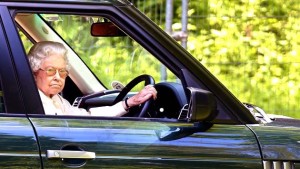
Queen Elizabeth II behind the wheel
After the death of King Abdullah in January, 2015, a story surfaced about the time he’d visited Queen Elizabeth II back in 1998. The then-Crown Prince was treated to a tour of Balmoral, the Queen’s estate in Scotland.
He took his royal seat in the Land Rover, but was shocked when the Queen herself got behind the wheel. Showing off some quick moves she’d learned during World War II as a truck driver for the Women’s Auxiliary Territorial Service of the British Army, the Queen reportedly chatted with the terrified Crown Prince as she raced around the estate.
TO GO DEEPER
 Articles:
“Saudi Women’s Rights Campaigners ‘Freed from Prison’” on blog; Saudi Women Driving, February 12, 2015 (This is a whole blog devoted to the Saudi women’s driving campaign, with links to many articles.)
“Saudi Women Free After 73 Days in Jail” by Robert Mackey, The New York Times, Feb. 12, 2015
“Saudi Arabia Women Test Driving Bans” by Jason Burke, The Huffington Post, June 17, 2011
Videos:
“Manal al-Sharif Defies the Saudi Arabian Driving Ban for Women” (1:21 minutes)
“Woman Drives, Major Side Effect: EMPOWERMENT (ovaries fine) Honk4SaudiWomen campaign” (2:35 minutes)
Satirical video, “No Woman, No Drive” by Fahad Albutairi, a popular comedian married to Loujain al-Hathloul
 Beheadings are in the news. So is romance. They converge on Valentine’s Day, named for a priest who was beheaded in Rome on February 14, 270.
 We recoil from images of recent beheadings and immolations by ISIL. But President Obama, in his February 5th address at the National Prayer Breakfast, reminded us that, like today’s Muslims, Christians, too, have seen their faith perverted when atrocities were committed in their name.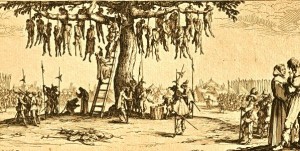
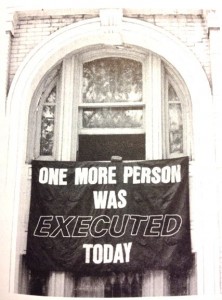 > Banner Project: In the early 20th century, the NAACP led an anti-lynching campaign. Each time news was received that a person had been lynched, they hung a banner outside the NAACP’s NYC office that read, A MAN WAS LYNCHED YESTERDAY. Decades later, when Rev. Dr. Constance M. Baugh read about this, she was inspired to institute a similar practice at Brooklyn’s Church of Gethsemane (Presbyterian Church USA) to keep the community mindful of capital punishment and, on appropriate days, hung a banner from a 2nd-story window: ONE MORE PERSON WAS EXECUTED TODAY.
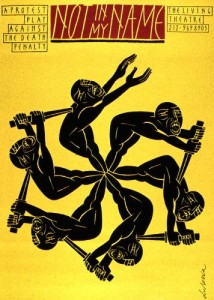 > Not In My Name: On evenings when an execution was scheduled somewhere in the nation, members of the pacifist-anarchist Living Theatre gathered at Times Square to perform Not In My Name, a street theater play about ending the death penalty’s cycle of violence and revenge. Judith Malina cofounded The Living Theatre with Julian Beck (1925-1985). She and members of the troupe performed the 15-minute protest play at the publication party for my anti-death penalty book in 2003! (In Luba Lukova’s brilliant poster, one person is shown breaking the cycle — an image of hope.)
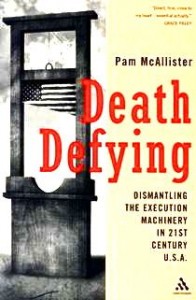 Death Defying: Dismantling the Execution Machinery in 21st Century U.S.A.
  When Ruth Powell arrived in D.C. in 1941, she was warned not to expect to eat in the downtown area. Raised in a Boston suburb, she had no experience with the Jim Crow South. The warning barely registered. The young student was excited about attending Howard University in the nation’s capital.
 One January day in 1943, Ruth and two other coeds ordered hot chocolates at a store on Pennsylvania Avenue. At first, they were refused service. When the three women didn’t move, the police were called. To the women’s surprise, the cops ordered the waitress to bring the hot drinks. The catch came at the end: instead of being charged ten cents each, the drinks were billed at 25 cents. Ruth and her friends protested the overcharge and left the correct amount on the counter. That’s when they were arrested, taken to jail in a police wagon, and held under suspicion of being “subversive agents.”
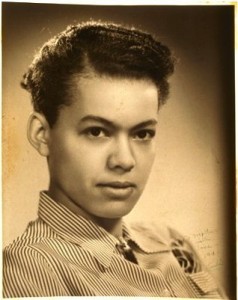 Good news! One activist can inspire another. Ruth Powell inspired her fellow Howard U. classmate Pauli Murray (1910-1985). A diminutive, cross-dressing, woman-loving, radical black activist ahead of her time, Murray not only imagined the power of a sit-in campaign long before it caught on in the 1960s, but she coined the term “Jane Crow” to describe the varieties of oppression faced by black women, was arrested in the 1940s for not moving to the back of the bus, won the deep respect and friendship of First Lady Eleanor Roosevelt, was a co-founder, with Bayard Rustin, of CORE (Congress of Racial Equality) and NOW (National Organization for Women), became a lawyer, and, eventually, the first black woman Episcopal priest. In 2012, 27 years after her death, she was named an Episcopal saint.
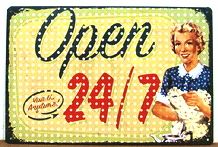 The following spring, however, the students met with disappointment after initial success at integrating Thompson’s cafeteria, part of a national chain located in downtown D.C., open 24 hours a day.
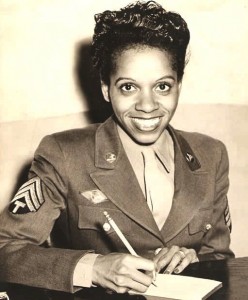 Like Powell, Edna Griffin (1909-2000) was a New Englander. After graduating from Fisk University in Tennessee, she moved to Iowa in 1947 with her husband, a med student.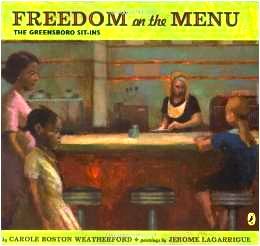
 # 1: DETERMINED IN DETROIT ~ On a chilly February morning in 1937, one of the worst years of the Great Depression, a union organizer stood in the middle of the Woolworth’s store, blew a whistle, and shouted, “Strike, girls, strike!”
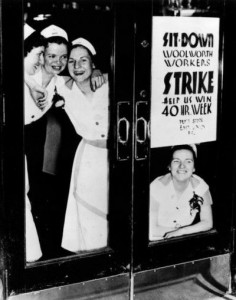 Frank Woolworth, the store’s founder, knew how to turn a profit, the way Walmart does today. He said, “We must have cheap help or we cannot sell cheap goods.”
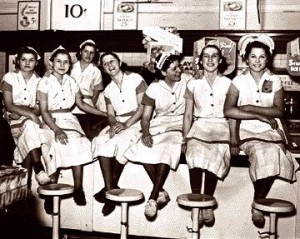 By all accounts, the week-long occupation was more fun than bother for the young women, many of whom had never spent a night away from home. They formed committees, including a “cheer-up committee” in charge of morale. They played cards, danced, knitted, and made up a song about Barbara Hutton, the Woolworth heiress, whose lavish débutante ball in the midst of the Depression had secured the disdain of the strikers:
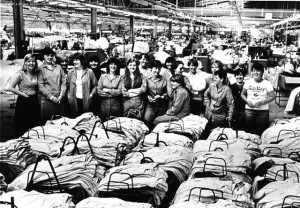 On another wintry February day, this one in 1981 in Greenock, Scotland, women workers at a Lee Jeans factory learned that the American owners planned to move the plant to Northern Ireland.
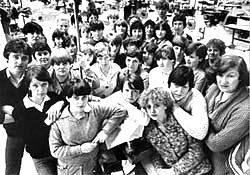 Like something out of an action movie, two workers climbed through a skylight, then shinnied down a drainpipe and ran to buy fish, chips, and Irn-Bru, a Scottish soft drink, enough for everyone. Stopped by police as they returned with 240 fish suppers, they explained that the workers were occupying the factory to save their jobs; the cops helped them with the doors.
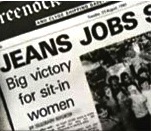 To raise funds, two women travelled across Scotland speaking to trade unions. Everywhere, they got standing ovations.
 Five girls chat about hair on their way downstairs to Sunday school, as if they have all the time in the world. We’re mesmerized by their nonchalance; we know that only one will survive the descent.



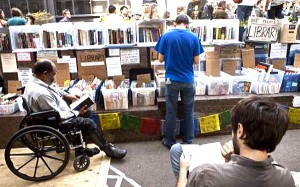
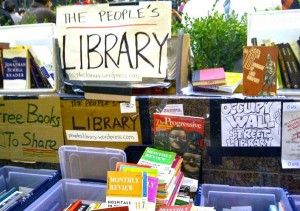 And then they came for the People’s Library, our library, the library of the 99%, the Occupy Wall Street library in Zuccotti Park.
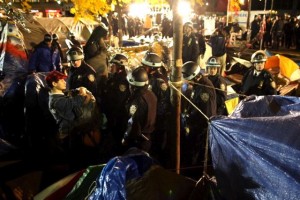 Librarians were arrested that night. So were journalists and protesters. Police in riot gear obeying orders of the billionaire mayor, emptied the park.
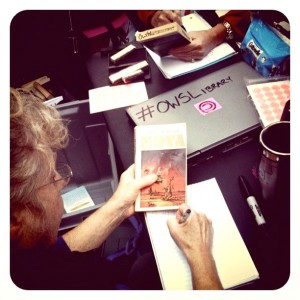 We worked quietly — accepting donations, sorting, cataloguing, stamping the books (my job), then passing them on to be properly shelved and lent out. Meanwhile, the occupation buzzed around us.
 A contingent of seminarians wearing clerical collars stood silently off to one side with signs: “CLERGY — WILLING TO LISTEN.”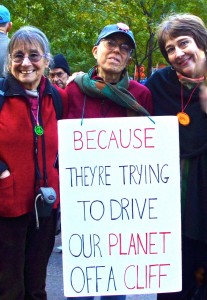
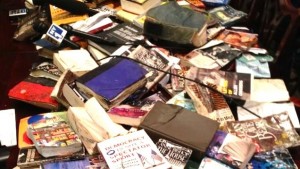 After the police raid, there were massive demonstrations, but the occupation of Zuccotti Park was essentially over.
 I, too, was reminded of a futuristic, dystopian novel — Fahrenheit 451 by Ray Bradbury, in which books are banned, incinerated by “firemen.” A few people, in exile, memorize whole books, hoping to retain each sentence until the day books can be legally published and read.
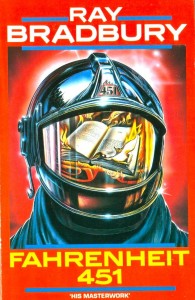 Fahrenheit 451
 At Christmas, I waved goodbye to the wreath-draped lions in front of NYC’s Library on Fifth Avenue (a.k.a. “the People’s Palace”) and rode Amtrak to Rochester to visit my sister and her husband. This year, our cousin Erin joined us, driving up from Ohio.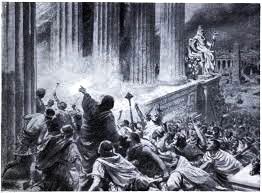
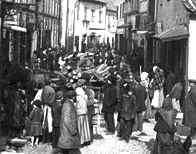
 The Nazis smirked at Šimaitė, fussing over a few books. After all, they regularly burned great heaps of books and, in 1941, looted and destroyed the world’s largest library of Jewish learning, the Strashun Library, a landmark in Vilna.
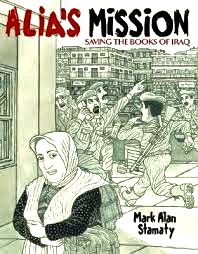
 “In the Koran, the first thing God said to Muhammad was ‘Read!.’” That’s what Alia Muhammad Baqer (Baker) told a reporter for The New York Times.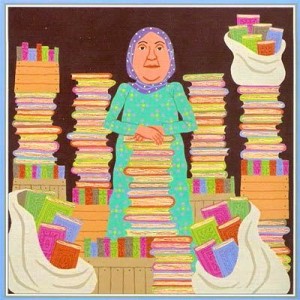
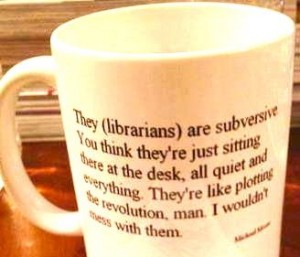 When bombs began to fall, Baqer organized the library staff and book-loving neighbors. Together, they passed books out of the library, over a wall, and into the restaurant of a friend. They worked until midnight and promised to return in the morning.





 “White privilege” means never having to say you noticed — never noticed landlords who refuse to rent, banks that refuse to lend, employers who won’t employ, taxis that refuse to stop, never noticed the pain caused by racial slurs and jokes, never noticed the lack of parks or after-school programs in minority neighborhoods, never noticed store personnel following black customers, never noticed the “school-to-prison-pipeline” with black students less likely to be assigned experienced teachers and well-equipped classrooms, more likely to be suspended or expelled for misbehavior, never noticed commuters pulled over for “driving while black,” police brutality disproportionately born by African-Americans, prisons bursting at the seams with black and brown people …
 In 1997, I was disheartened by apparent white apathy after the police brutalization of Abner Louima. I went to a Brooklyn rally (photo) and could count the white protesters on one pale hand. History has brought us to a new day, when people of all races, classes, beliefs are coming together in rage, despair, and hope.
 “White privilege” means treating the killings of Mike Brown and Eric Garner as unfortunate “incidents,” denying the long history of institutional racism and the systemic targeting of people of color. It means saying, in condescending tone, “Well, really, all lives matter, don’t they?” or derailing deep conversation with the truism “But not all cops are bad,” (reminiscent of the meme “not all men” as rebuttal to outrage about rape and battery), or insisting that people of color stop what they are doing to educate white folks about our shared history.
 Violence against black and brown peoples has been relentless from the start. It’s been “status quo” and “the way things are.” People of color silently mourned or seethed, while the white majority barely noticed. In our silence we acquiesced.
 Police over-reaction in Ferguson revealed something many of us (myself included) had not known: the Defense Department has been arming local police with surplus equipment since 1997 — tanks, full battle gear, tear gas. Now, at last, we’re talking about the “militarization of America’s police.” That we’re talking about it is a good thing.
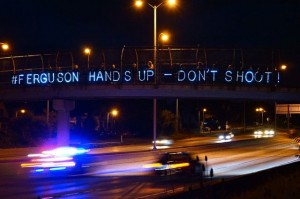 But this time, nothing is stopping creative protest — not media distortion, not chilly winds, rain, snow, not even Christmas. Has the world ever seen anything quite like this?
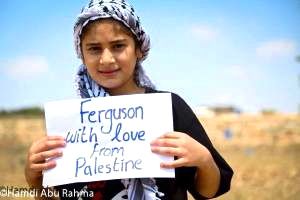 In Milwaukee, the Overpass Light Brigade created a digital sign on a pedestrian overpass bridge. Medical students held “white coat die-ins” at Yale, Tulane, Johns Hopkins, and several dozen other schools.
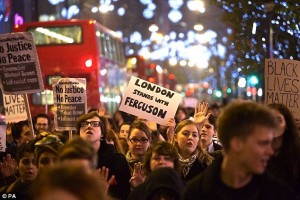 “Which Side Are You On?” was also sung by protesters at the St. Louis Symphony. Diverse in race, age, and gender, they bought tickets, stood up mid-concert, sang a “Requiem for Mike Brown,” and left of their own accord, as they tossed confetti hearts and unfurled banners from the balcony. Some on stage and in the audience applauded, others booed or sat open-mouthed.
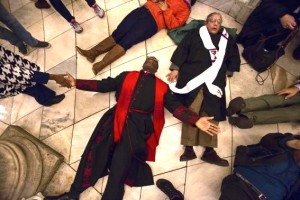
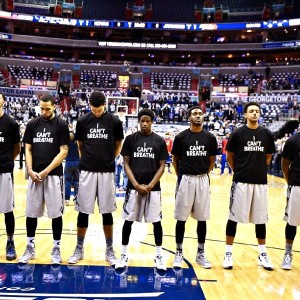 People of faith are holding vigils, die-ins, prayer meetings, and rallies. They’re hosting after-church racism discussions.
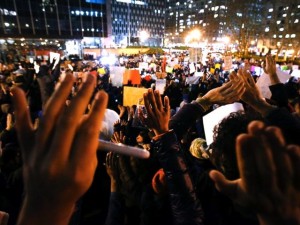 Many thousands of protesters are expected to flood Washington, D.C. this weekend for the March Against Police Violence. There’s a whole new anti-racism movement on the move now, led by young people who are both informed and savvy about how to use the new technology.
 In November 1980 and again in ‘81, women gathered at the Pentagon to mourn, rage, empower, and defy, in a pageant-like demonstration that combined rational thought with deep emotion.
 With input from over 200 women, author-activist Grace Paley drafted a jargon-free manifesto called the Unity Statement. In her essay, “All Is Connectedness,” Ynestra King, an ecofeminist activist-scholar, wrote that the process of collectively creating the Unity Statement set the tone for the actions to follow.
 In the first stage, thousands of women walked to the beat of a slow drum through Arlington Cemetery, past endless neat rows of tombstones. They were led by a giant Bread and Puppet Theatre papier-mâché figure. (The first year it was draped in black, the second in white.) When they reached Pentagon property, they knelt to place homemade grave-markers: “Mary Dyer,” “Anne Frank,” “Karen Silkwood,” “My mother Roberta, self-induced abortion, 1964,” “the Salem witches,” “the mother of the soldier my son killed in Vietnam.”
 From rage evolved the third stage. Another puppet appeared to lead the way (the first year gold, the second year black). The empowerment puppet held a basket of scarves. The women helped themselves as they began to encircle the Pentagon, a building one mile in circumference. As they circled, they read aloud the Unity Statement and sang, “We Shall Not Be Moved,” “Song of the Soul,” and “You Can’t Just Take My Dreams Away.” By using the scarves to connect woman-to-woman, the circle finally closed around the war building, and the women gave an exultant whoop of victory. (Photo: WPA logo, designed by Vermont artist-activist Bonnie Acker.)
 The fourth stage began. Women who had taken workshops on nonviolent civil disobedience began the work of blocking three of the five major entrances to the Pentagon. Some of the women sat on the steps, linking arms and letting their bodies become limp as soon as officers approached to arrest them. (Photo: Grace Paley being arrested)
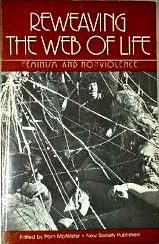 When New Society Publishers went to press with my 448 page anthology, Reweaving the Web of Life: Feminism and Nonviolence, featuring essays by Joan Baez, Barbara Deming, Karla Jay, Holly Near, Alice Walker, and dozens of other author-activists, several photos of the WPA were included inside, as well as one on the cover by Joan E. Biren (or JEB). Unfortunately, some readers, unfamiliar with feminist symbolic use of webs to block entrances, thought the women were caught in the web.
 When the book was reprinted, a different cover photo was chosen, this one, also by JEB, showed cheering women triumphantly holding a web over their heads.
 In November, 1981, several months before the book’s publication, Grace Paley and several other New York-area contributors to Reweaving joined me in a reading at the Woman’s Salon, co-founded by Erika Duncan. What a night it was! (Photo, L-R: Erika Duncan, one of her daughters, me, Grace Paley, Leah Fritz, and Catherine Reid.)
 Grace Paley: Collected Shorts by Lilly Rivlin