On November 22, 1909, young Clara Lemlich sat beside other garment workers, listening to speeches in the Great Hall of New York’s Cooper Union. Her body was bruised and aching after the beating she’d taken two days earlier on the picket line. In late September, she and 100 other women had walked out of their factory on the Lower East Side. They’d had enough.
Working conditions at the garment shops were deplorable. The women and girls, some as young as eight, worked from 7:30 in the morning to 6:30 or later each evening, sewing “waists,” women’s blouses. Very few took home more that $6 a week after a full seven days of work. Most were Jewish or Italian immigrants who provided for their families and sent what they could to relatives in Europe. Out of their low wages, they paid work expenses and fines.
The shops were stifling in summer and freezing in winter. There was rarely any ventilation or clean water. Most of the shops were fire traps, something that wouldn’t be taken seriously by management until the Triangle Waist Company fire in March, 1911.
SHE HAD FIRE IN HER MOUTH
 On November 22, Clara (photo), already arrested numerous times and still in pain from her most recent beating, was determined to attend this meeting — but what a disappointment! Two hours of long-winded speeches and cautious rhetoric was more than enough. The men droned on and on. Couldn’t they feel the tension in the room? the readiness? the ache for action?
On impulse, Clara stood and interrupted a speech, calling out, “I’ve got something to say!” Years later, she would recall, “Ah — then I had fire in my mouth … Audacity — that was all I had — audacity!”
The moderator, as surprised as everyone, decided that the young striker had as much right to the platform as he did. He granted her request. As Lemlich made her way to the podium, several thousand people strained to see the one they called “a pint of trouble for the bosses.”
“I am a working girl,” she called out, “one of those who are on strike against intolerable conditions.” The workers knew what she was talking about. “I offer a resolution that a general strike be declared — now!”
The mass of workers rose to their feet as one body, shouting, waving their hats and handkerchiefs for a good five minutes. When at last the crowd settled down, the moderator asked if anyone wanted to second Clara’s resolution. Again, the room erupted with people on their feet, shouting. Everyone in the Great Hall seconded the motion. Then, Clara led them all in the Yiddish oath: “If I turn traitor to the cause I now pledge, may this hand wither from the arm I now raise!”
“WE ROSE AND WON WITH WOMEN’S MIGHT!”
 Messengers ran with the news to where other garment workers were meeting. They, too, endorsed the call for a general strike. Over the next two days, women from over 500 shops walked out in the first great strike of women.
Out on the picket lines, the women were cold in their thin coats and over-sized hats, hungry, and subjected to public humiliation and arrest. The bosses hired thugs to beat them up. One reporter for the New York Sun described the scene:
The girls, headed by teenage Clara Lemlich … began singing Italian and Russian working-class songs as they paced in twos before the factory door. Of a sudden, around the corner came a dozen tough-looking customers, for whom the union label “gorillas” seemed well-chosen.
“Stand fast, girls,” called Clara, and then the thugs rushed the line, knocking Clara to her knees, striking at the pickets, opening the way for a group of frightened scabs to slip through the broken line.
As is often the case with violent tactics, the employers’ brutality backfired and, instead of frightening the picketers away, strengthened their resolve and won support for the strike by heightening public sympathy for the workers.
The strike lasted four months. The “Uprising of the 20,000” left the majority of those who’d gone on strike with improved conditions, a shorter work week, union representation, and better pay. Hard-working women had tasted worker solidarity, union organizing, and the power inherent in nonviolent collective action.
Later, they sang a song written by members of the International Ladies Garment Workers Union:
In the black of the winter of nineteen nine,
When we froze and bled on the picket line,
We showed the world that women could fight
And we rose and won with women’s might.
TO GO DEEPER
Books
 Brave Girl: Clara and the Shirtwaist Makers’ Strike of 1909 by Michelle Markel, Balzer & Bray, 2013 — A picture book for children.
Rivington Street (a novel) by Meredith Tax, University of Illinois Press, 2001. Originally published in 1982, Rivington Street paints a vivid picture of the Lower East side and the women garment workers and other East European Jewish immigrants who lived and worked there at the turn of the last century. This review includes an audio clip of Tax reading a few pages of her fictionalized account of the beginning of the Shirtwaist Strike.
We Were There: The Story of Working Women in America by Barbara Mayer Wertheimer, New York: Pantheon Books, 1977.
Other
Labor Arts presents the Clara Lemlich Social Activist Awards (website)
“Cooper Union” Zachary Aarons tells the story of Clara Lemlich’s famous speech (2 minutes)
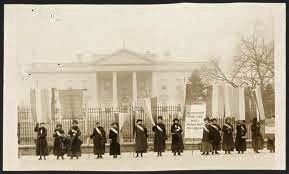 The “Night of Terror” is what suffrage activists in the United States later called November 14, 1917.
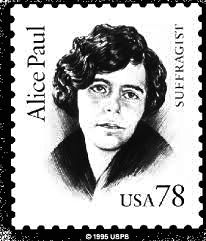 In the days leading up the the Night of Terror, radical suffrage leader Alice Paul was arrested and, in an effort to undermine her credibility, sent to a psychiatric ward,. There, she was denied legal counsel.
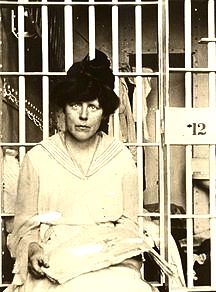 In the midst of the chaos, Lucy Burns (in photo), a fearless redhead from Brooklyn, began to call the roll and bring a sense of order. Her strong voice calmed the others.
 Alice Paul: Equality for Women
  Century of Struggle: The Woman’s Rights Movement in the United States
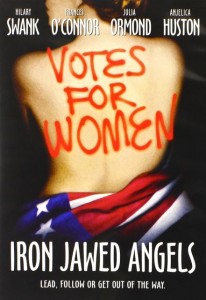 FILM: Iron Jawed Angels
 It didn’t take much for suffrage activists to be considered hecklers in early 1900s England. Bold activists like mill-worker Annie Kenney and privileged Christabel Pankhurst united across class lines to interrupt male politicians and ask, “When will the government give women the vote?” Outraged blokes cursed, shook their fists, and threw stuff — dead fish, rotten eggs. The women often got roughed up and arrested. Still, nothing stopped them.
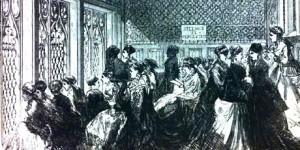 Suffrage activists waited for hours that day to hear men debate the resolution. Instead, they heard condescending jokes and raucous laughter.
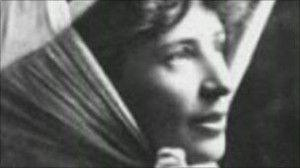
 The women continued to swarm men’s meetings, heckle the speakers, and laugh. On October 28, 1908, a suffrage activist and professional actress from Australia, Muriel Matters, interrupted the proceedings at the House of Commons to deliver a speech from the Ladies’ Gallery. When guards rushed to evict her, they found that she had chained and padlocked herself to the grille.
 But, this wasn’t the end of Muriel. A few months later, on the day King Edward opened Parliament with a grand procession, Matters hired an airship bearing the words VOTES FOR WOMEN, stepped into a basket on the balloon’s underside, and, once aloft, floated over London, tossing leaflets overboard. She meant to drop the pamphlets on the King’s head, but was blown off course. Nevertheless, she won lots of publicity for the suffrage cause and had a good time doing it.
 “
“
 On November 1, 1961, women across the United States — homemakers and factory workers, clerical workers and waitresses — interrupted their daily routines and took to the streets in the Women’s Strike for Peace.
 The symbolic strike by women was the brainchild of Dagmar Wilson, a children’s book illustrator and mother of three daughters. A few weeks earlier, she had read a statement by Bertrand Russell, winner of the 1950 Nobel Prize for Literature and a philosopher some called the spiritual leader of the civil disobedience movement in England: “I cannot bear the thought of this beautiful planet spinning timelessly in space — without life.” That sentence resonated with Wilson.
 Though it was conceived as a one-day action, the Women’s Strike for Peace (WSP or WISP, as it was sometimes called) continued long past November 1, 1961. Rather than get bogged down in the trappings of an organization, WSP mobilized women to join already established peace groups and to spread their influence on a local level through the Parents and Teachers Associations (PTA), churches, and bridge clubs. WSP set up pickets, demonstrations, and letter-writing campaigns. It promoted nationwide boycotts of milk after every atmospheric nuclear test to protest contamination from fallout.
 On October 24, 1975, Iceland came to a virtual standstill when women took the day off. They left their typewriters and steno pads, put down their paint brushes, music books, and lecture notes, took off their aprons, left the dishes in the sink. Actresses walked off the stage. Teachers left their classrooms. Tellers grinned as nervous bank executives stepped up to the window. Moms and daycare workers handed the children over to dads. They didn’t do the shopping or get dinner. Fish factories ran at half-capacity. Planes were grounded for lack of flight attendants. Phones went unanswered. Newspapers weren’t typeset.
 In Reykjavik that day, 25,000 women, bundled in coats and scarves, streamed out of their homes and workplaces to attend a rally. They came from all walks of life, political parties, religious beliefs, union affiliation. Some chanted and sang, others stood quietly, tears in their eyes. They listened to speeches and waved homemade placards calling for equality, progress, peace.
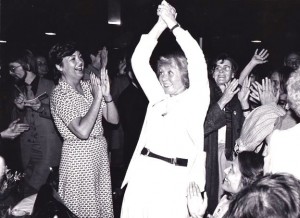 In 1985, they did it again. By now, Iceland had a female president, Vigdís Finnbogadóttir (photographed cheering the day she won the election). A single mom, she stayed home in solidarity with the symbolic strike.
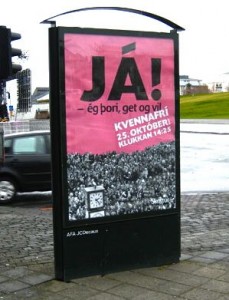 By 2010, everything was different. The name of the action had changed from “Women’s Day Off” to “Women Strike Back.” Instead of a sunny day, the 50,000 who rallied in Reykjavik defied storm warnings and stood in freezing rain. Violence against women was still a focal point of the protest, but the economic and political landscape had changed. Following a global economic crash, Iceland had gone from one of the world’s wealthiest societies to total economic collapse in 2008, largely, it was held, due to the excesses of mostly male bankers and politicians.
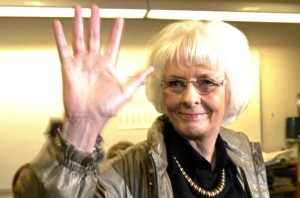 In response, the electorate voted in Jóhanna Sigurdardóttir as prime minister, the first openly-lesbian elected leader in world history. A new gender-neutral marriage law, passed in June 2010, legalized same-sex marriage. A few days later, Jóhanna married her longtime partner, Jónína. (Icelanders go by their first names, according to tradition.)
 Courageous action arises from places of misery and oppression — places like Victorian London’s East End.
 In 1888, several months before Jack-the-Ripper killed and mutilated six women in the East End, Annie Besant, a crusading journalist, heard about the deplorable work conditions at the Bryant & May match factory which employed many women, most of them teens. She made up her mind to spark public concern with her writing.
 Low pay and 12-hour days were not the workers’ only hardship. The factory air was thick with phosphorus. White sulphur, used on match tips, got onto the workers’ fingers. They ate at their work benches, Annie wrote, “disease the seasoning to their bread.” Poisoned by their work, the young women often became bald, and some developed “Phossy Jaw,” a disease that literally ate their faces.
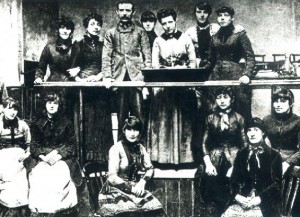 The company threatened a libel suit and insisted that all workers sign a petition certifying that Besant’s article was untrue, exaggerated at best. Despite their desperate straits, not one worker signed.
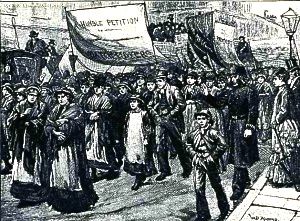 The highlight of the strike came when the matchgirls marched to the House of Commons. A delegation of young workers was allowed to enter and speak about their lives in their own words. One fifteen-year-old pulled the scarf from her head to show that she was almost completely bald. The MP’s were shocked.
 Regretting bad publicity, the directors of Bryant & May met with strike representatives and agreed to all their demands, including better wages, a separate room where the workers could eat, and the abolition of fines. The matchgirls’ successful strike is still celebrated in British labor history.


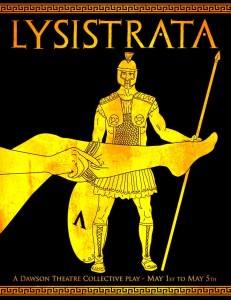 In Lysistrata, that bawdy old Greek comedy, scantily clad women fed up with the Peloponnesian War lured their warrior husbands home, then slammed shut the bedroom doors, so to speak, promising to open up when peace was declared.
 ● @1600, Iroquois Nation — Noting that they produced the warriors, women threatened to forego childbearing until men conceded some decision-making powers on the war council.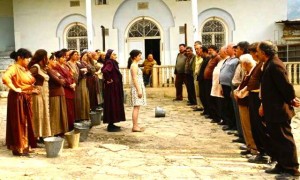
 ● 2006, Colombia — Proclaiming a “strike of crossed legs,” women in Pereira withheld sex to stop gang wars and drive home the point that violence is not sexy. The ten-day strike may have worked. By 2010, Pereira’s murder rate declined by 26.5 percent.
 ● 2011, Philippines — Women in a sewing cooperative on rural Mindanao Island were unable to sell their wares because violence between men in rival villages had closed the main road. They called for a sex strike. Within a few weeks, the road was opened and deemed safe for travel.
 ● 2012, USA — The Texas-based Liberal Ladies Who Lunch set up a Facebook page urging women to withhold sex for a week, not as a weapon against men, but as a reminder that “if women lose our hard won rights to medical care, birth control, and pregnancy choice, it won’t only affect women.” The strike proposal was made somewhat tongue-in-cheek, but the demand that congress and insurance companies cover contraception was serious.
 Musical & Theatrical Sex Strikes:
 The 2001 Turkish sex strike inspired two modern films. The 2008 award-winning German-French comedy Absurdistan, directed by Veit Helmer and filmed in Azerbaijan, tells about two young lovers in a remote Soviet village, caught up in a sex strike for repair of a water pipeline. Absurdistan (2 min trailer)
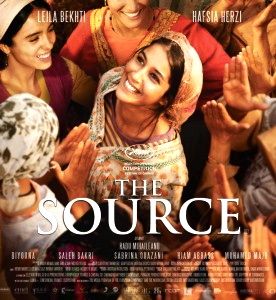 The 2011 French film, The Source, directed by Radu Mihāileanu, is set in a small Arab village in North Africa, where women go on a “love strike” to protest their hard labor carrying water from the mountains. (2-minute trailer)
 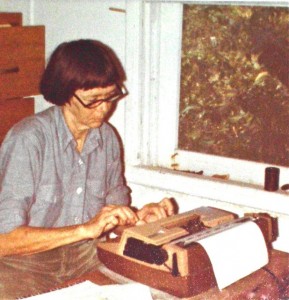 If women ever really went on strike and refused our assigned roles, “Everything, everything would have to change!” So wrote my mentor, Barbara Deming (1917-1984), pacifist, lesbian-feminist author-activist.
 “You can’t make fundamental changes in society without the occasional mad act.” That’s what President Sankara boldly proclaimed when he came up with the idea for “Market Day for Men.” Indeed, it seemed a mad act.
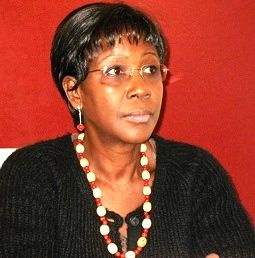 In the few years before his assassination and the coup, President Sankara appointed several women to high positions, including second in command at the Ministry of Defense. For Minister for Health and Family Welfare, he appointed Joséphine Ouédraogo. She was trained as a sociologist and worked for the revolutionary government from 1984 to 1987.
 The mid-1980s was a time of great change in Burkina Faso, a country that traditionally had a strict division of labor along gender lines. In September, 1984, with the blessing of both President Sankara and Minister Ouédraogo, the women in the Committee for the Defense of the Revolution called for a one-day women’s strike and, simultaneously, a “Market Day for Men.” They urged community leaders — priests, imams (Muslim prayer leaders), teachers, and news reporters — to encourage support for the experiment.
 At each marketplace, the men were greeted by teams of militant women from the Committee for the Defense of the Revolution. They stopped women from entering the markets unless they were single or had husbands who were ill that day.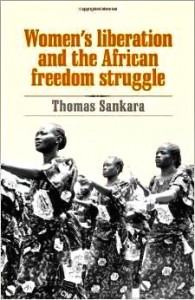
 Am I in love? Maybe. I’ve never met her, but she’s a 30-something street artist/ social justice activist who goes by the tag Swoon, although her birth name is also pretty fabulous — Caledonia “Callie” Curry. For years, her powerful portraits could be found illegally wheat-pasted on the sides of neglected buildings in gritty Brooklyn’s back alleys.
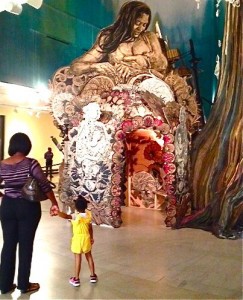 “Submerged Motherlands”
 From the clutter representing our fragile, dislocated lives with their alarming cycles of growth and decay, rose a magnificent fabric tree (akin to the sacred but endangered Mapou in Haiti). It drew our gaze, repeatedly, to the rotunda skylight, as if we might find relief from our environmental anxieties up there with the delicate cut paper foliage. Swoon believes “we can create little cracks in the façade of impossibility and inevitability.” Standing at the foot of that tree, I, too, believed.
 “Earth Ambulance”
 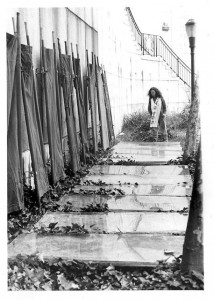 The caravan arrived in New York City in time for the historic June 12th March for Disarmament. The women unloaded the full pillowcases from the ambulance and poured the soil onto old army stretchers from Korea and Vietnam.
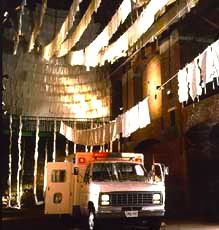 Months later, pillowcases from the Earth Ambulance were hung like laundry on clotheslines in Dag Hammarskjold Plaza. For two weeks, people stopped to read Earth dreams and nightmares. At night, women camped out there, the dream-laden “sacks” hanging over them, waving in the breeze. Plaza police looked on, mistakenly assuming that official permission had been granted.
 SWOON
SWOON HELENE AYLON
 Something was very wrong, and Wangari Maathai knew it. She saw that women in Kenya had to walk farther each day for water and wood and realized that the cause was a policy of rapid deforestation which had left big swaths of the nation bare and dusty. The authorities didn’t seem to care.

 When Wangari Maaathai died of cancer in September, 2011 at age 71, the whole world mourned. The executive director of the United Nations’ environmental program remembered her as a force of nature and compared her to the acacia trees, “strong in character and able to survive sometimes the harshest of conditions.”